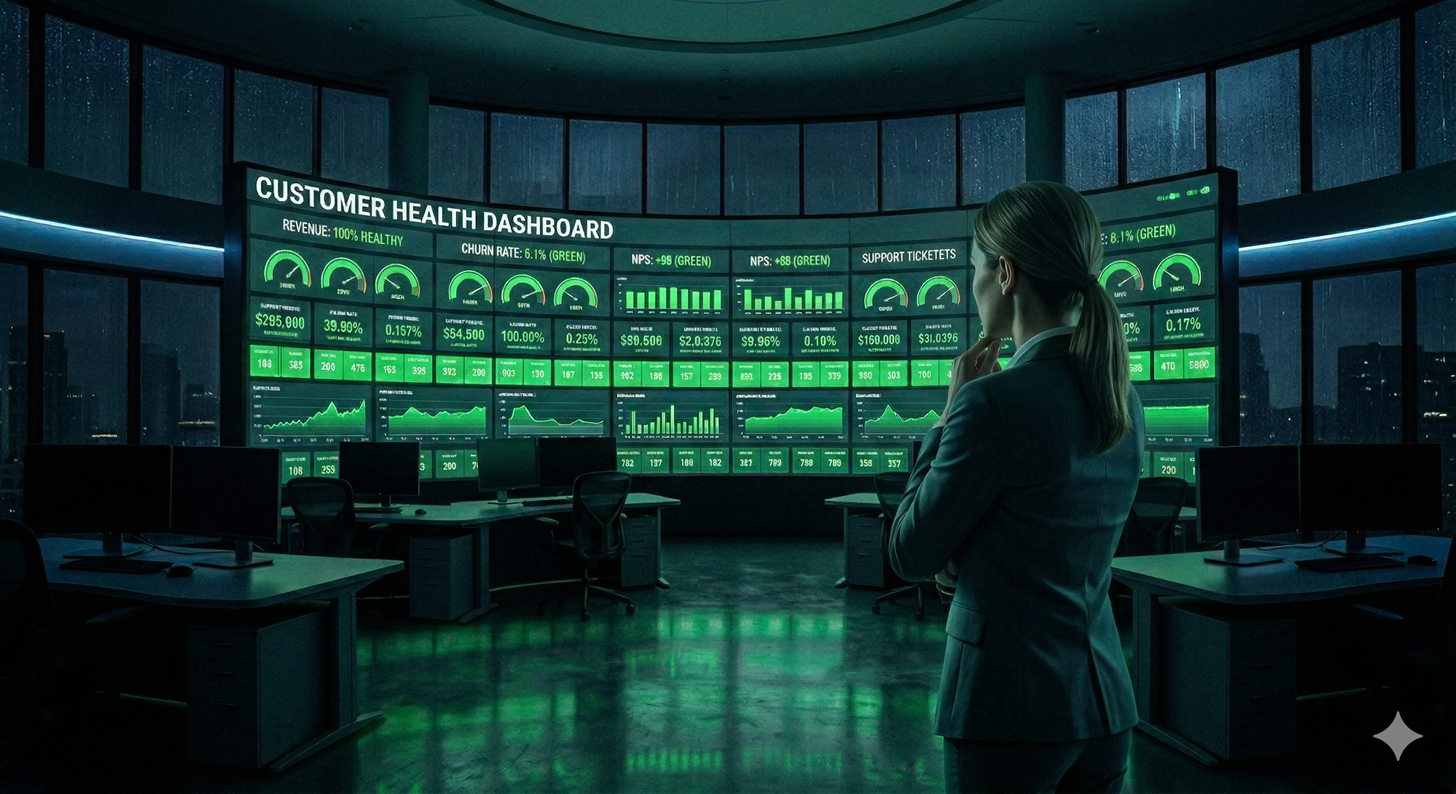

The subscription economy changed the rules of B2B revenue. Buyers now re-evaluate every renewal with the same scrutiny they brought to the original purchase. Procurement teams are consolidating vendor stacks. AI alternatives are creating new pressure. Some organizations are now asking vendors to justify why a solution cannot simply be rebuilt in-house with AI.
The era of expanding logos on the promise of future value is over. Value has to be current, specific, and proven at the right level of the customer organization.
Most B2B companies are not ready for this. And the CLG maturity model shows exactly where they are stuck.
What Is the CLG Maturity Model?
The Customer-Led Growth (CLG) maturity model is a five-stage framework that assesses how effectively a B2B organization turns customer value creation into a systematic growth engine. It evaluates four dimensions: organizational model, measurement approach, AI use, and customer journey design.
The five stages are:
Stage 1 — Reactive
Customer Success operates as a support queue. Metrics are NPS, CSAT, and ticket volume. There is no proactive value motion.
Stage 2 — Aware
CS owns renewals with minimal expansion focus. Basic health scores and churn rate tracking are in place. Value is discussed but not systematically defined or measured.
Stage 3 — Aligned
CS, Sales, and Product share journey goals. Time-to-value and expansion ARR are tracked. End-to-end journey mapping exists, though execution is still largely siloed.
Stage 4 — Predictive
Dynamic value scoring is applied per customer segment. AI powers health dashboards, churn prediction, and executive briefing generation. Value realization is measured continuously, not quarterly.
Stage 5 — Orchestrated
The entire GTM motion is unified around customer-perceived value. AI orchestrates plays, alerts, and cross-functional alignment in near real time. The CCO operates as a revenue peer to the CRO.
Most enterprise organizations sit at Stage 2 or 3. They have invested in CS headcount, built some measurement capability, and launched a health scoring model. The function is still largely reactive. Data is still siloed. The connection between CX activity and financial outcomes is assumed, not demonstrated.
The full CLG maturity framework, including self-assessment criteria and a transformation roadmap, is documented at a6group.com/customer-led-growth-framework.
What Moving from Stage 2 to Stage 3 Actually Requires
The shift from Stage 2 to Stage 3 is primarily an alignment problem. At Stage 2, CS owns renewals but operates in isolation. Sales closes deals and moves on. Product builds to its own roadmap. Nobody shares a definition of what a successful customer actually looks like.
Moving to Stage 3 requires three things. First, a shared journey. CS, Sales, and Product need to agree on what the customer experience should look like from initial sale through first value milestone — and who owns each stage. Second, expansion ARR needs to become a tracked metric, not an occasional upside. If CS is not measured on expansion, it will not prioritize it. Third, time-to-value needs to become a first-class signal. Slow time-to-value is one of the strongest early churn predictors, and most Stage 2 organizations are not tracking it at all.
The jump from Stage 2 to Stage 3 does not require AI or a major technology investment. It requires cross-functional conversations that most organizations are actively avoiding.
Why the Pre-Sales and Post-Sales Divide Keeps Organizations Stuck
The single biggest structural barrier to CLG maturity is the handoff culture inherited from Sales-Led Growth.
In a traditional SLG motion, the customer journey is a relay race. Marketing qualifies and hands off to Sales. Sales closes and hands off to Professional Services. Professional Services deploys and hands off to Customer Success. Customer Success manages renewals and hands off issues to Support. At every transition, context is lost, value narratives degrade, and accountability diffuses.
Post-sales teams rarely know why a customer bought or what business outcomes they were promised. Pre-sales teams rarely learn whether any of that value was actually realized. The loop never closes.
The result is a customer journey that looks continuous on a diagram and functions as two disconnected operating models in practice. Pre-sales runs on urgency, personalization, and persuasion. Post-sales runs on onboarding scripts and reactive support. Calling that a flywheel does not make it one.
What Is the Gap Between CLG Stage 3 and Stage 4?
The gap between Stage 3 and Stage 4 is not a technology problem. Organizations at Stage 3 typically have access to the tools they need. The gap is an alignment and execution problem.
Three things are missing at Stage 3:
1- A shared definition of value
Sales, CS, and Product each operate with different assumptions about what a successful customer looks like. Without a unified value framework, every team optimizes for its own metrics and the customer experience fractures at every handoff.
2- Cross-functional ownership of the customer journey
Journey mapping at Stage 3 is typically owned by CX or CS in isolation. Moving to Stage 4 requires a CLG Council — a cross-functional forum where Sales, Marketing, CS, and Product review value insights and journey performance together, with shared accountability for outcomes.
3- AI applied to value measurement and orchestration
Static health scores updated manually cannot keep pace with the signals that actually predict churn and expansion. Stage 4 organizations use AI to build dynamic value models per customer segment, surface risks and opportunities in near real time, and generate the executive-level value narratives that CSMs need before every renewal conversation.
How to Assess Where Your Organization Sits Today
One diagnostic question cuts through the noise: if the CEO asked today for a direct line between last quarter’s CS activity and revenue retained or expanded, how quickly could that answer come — and how confident would it be?
Stage 2 and 3 organizations would struggle to answer. Stage 4 and 5 organizations have it ready.
A second signal: ask the economic buyer on a top renewal account to articulate the value the solution delivers. If they cannot, the value story has not reached the right level of the organization. That gap is both a churn risk and a starting point.
What Moving from Stage 3 to Stage 4 Actually Requires
The path from Stage 3 to Stage 4 is an alignment and operating model change, not a software purchase. It requires four foundational moves:
1- Build a shared value framework
Define the two or three primary value drivers for each customer segment. Align Sales, CS, and Product around those definitions. Make value realization the shared north star across all post-sales functions.
2- Bring Marketing and Sales into the post-sales motion
The value narrative that wins renewals starts in the sales cycle. Marketing and Sales must share the same definition of customer value as CS — and feed the insights, promises, and outcome language from pre-sale conversations directly into success planning. Without this, the handoff culture that breaks customer trust stays intact.
3- Unify customer data across the journey
Combine product usage, support interactions, contract data, call transcripts, and outcome metrics into a single customer-level data model. This is the foundation for dynamic value scoring and AI-powered plays.
4- Establish a CLG Council
Create a cross-functional forum with decision-making authority over customer journey design and value measurement — with Marketing, Sales, CS, and Product at the table. Not a status meeting — a governance structure with shared accountability for NRR, expansion ARR, and advocacy-driven pipeline.
Organizations that make these four moves create the conditions for Stage 4. AI accelerates the journey, but it cannot substitute for the organizational alignment that has to come first.
Explore the full CLG framework at a6group.com/customer-led-growth-framework.