
Something is breaking in the standard B2B revenue playbook. Pipeline generation is getting more expensive. Outbound response rates are declining. Marketing programs that worked two years ago are producing diminishing returns. And the teams that are still hitting their numbers are, more often than not, doing something different — not more automated, but more precisely timed.
The shift reflects a fundamental change in how B2B buyers behave. Buyers are further into their decision process before they engage a vendor. They are using AI and social tools to research, filter, and shortlist before a human conversation happens. And they have developed a near-zero tolerance for outreach that is irrelevant to what they are dealing with right now.
The response most outbound revenue teams reach for — better copy, more personalization, smarter sequences — addresses the symptom, not the cause. The cause is simpler and harder to fix: most outbound is not timed to anything real.
Signal-Based Revenue Systems address that directly, as an operating model that changes when you reach out, why, and with what — across new business, existing accounts, and everything in between.
What Is a Signal-Based Revenue System?
A Signal-Based Revenue System is the operational layer that tells your revenue team when to act, on which account, and with what message — based on observable business events rather than demographic profiles or arbitrary cadence schedules.
The core principle is straightforward: buying decisions in B2B are almost always triggered by change. A company that is stable, well-resourced, and running smoothly is unlikely to be evaluating new vendors. A company navigating a merger, a leadership transition, a major product launch, or an operational failure is in a fundamentally different state. The change creates a problem or an opportunity. The problem or opportunity creates a buying window. The buying window closes faster than most sales teams move.
A Signal-Based Revenue System is built to catch those windows — systematically, at scale, before competitors do.
This goes further than traditional intent data or trigger-based outreach in one important way. Most trigger-based approaches use generic signals: funding rounds, job changes, hiring surges. These signals are real, but they are now so widely monitored and so easily automated that they have lost most of their differentiation value. A Series B announcement generates seventy outreach emails in forty-eight hours. A job change fires sequences from a dozen competing vendors simultaneously.
The shift that matters is toward signals that are specific to the pain you solve and the moment your buyer is living through it. That requires a different kind of thinking — less about what data is available and more about what is actually happening inside your best accounts when they decide to buy.
The Three Components of a Signal-Based Revenue System
A functional signal-based system has three components that work together. Missing any one of them produces a system that detects without acting, acts without relevance, or reaches out without credibility.
1. The Signal Catalog
The signal catalog is the strategic foundation. It is a prioritized map of the business events and behavioral triggers that correlate with buying readiness or expansion potential for your specific ICP and solution.
Building it starts with a deceptively simple exercise: sit with your best customers and best-fit prospects and ask what was happening inside their business in the ninety days before they bought. What changed? What broke? What got announced? What pressure were they under?
The answers fall into three categories.
- External signals are observable events in the market: mergers and acquisitions, leadership changes, product launches, regulatory shifts, major events, funding announcements, earnings surprises, hiring patterns.
- Internal signals come from within your existing customer base: usage pattern changes, feature adoption gaps, expansion triggers, executive sponsor transitions, support ticket trends.
- Behavioral digital signals captures how prospects interact with your digital assets. These are useful as confirmation signals but carry less certainty than explicit external or internal triggers.
They all matter. External signals drive new business and expansion prospecting. Internal signals drive the Customer-Led Growth motion — catching the right moment inside accounts you already own before the window closes or the relationship drifts.
The signal catalog is not static. It should be reviewed and refined as you learn which signals actually convert and which ones look promising but produce noise. The best signal catalogs are built iteratively, validated against real pipeline data, and owned by a cross-functional team that includes sales, marketing, and RevOps.
KnowledgeOps — Building the Signal Catalog
For our fictitious use case, KnowledgeOps sells a content management system that excels at merging and reorganizing data from multiple sources. Their initial signal catalog was built around the obvious triggers: company size, tech stack, and generic intent data. Response rates were average. Conversion was unremarkable.
A retrospective analysis of their last twenty closed-won deals revealed a pattern: fourteen of them had gone through a merger, acquisition, or significant internal reorganization in the twelve months before signing. The content consolidation problem that followed those events was both painful and time-sensitive — exactly the conditions that make buyers move fast.
That single insight reshaped their signal catalog. Merger filings, acquisition announcements, and internal reorganization signals became tier-one triggers. Everything else moved down.
2. Playbooks Tied to Each Signal
Detecting a signal is the easy part. Knowing what to do with it — and having the content to back it up — is where most teams fall short.
A playbook in a Signal-Based Revenue System is not a sequence template. It is a signal-specific response protocol that includes who to contact, what to say, what content to share, and what questions to ask. The best playbooks do not lead with product. They lead with the problem the signal represents, demonstrate genuine understanding of what the account is going through, and offer something useful before asking for anything in return.
The most effective playbooks are built around content that earns the conversation. Not generic thought leadership. Operational guides, frameworks, and diagnostic tools tied directly to the moment the signal represents.
For KnowledgeOps, the acquisition signal playbook centers on a practical guide to content consolidation after a merger: what to audit, what to migrate, what to retire, where change management breaks down, and what most teams get wrong. That guide is genuinely useful to someone living through the problem. It also surfaces, without stating it directly, every limitation of a content management system that was not designed for that kind of complexity.
This is where Signal-Based Revenue Systems connect to the AI Demand Channel. The playbook content is simultaneously a sales tool and an AEO asset. A VP of Content at a company that just completed an acquisition, asking an AI assistant how to consolidate content across two organizations, should find KnowledgeOps’ framework in the answer.
When they do, KnowledgeOps arrives in the conversation with authority rather than interruption. The signal triggers the outreach. The playbook builds Share of LLM. Both happen from the same asset.
3. Detection and Execution Infrastructure
The third component is the technology layer that surfaces signals at scale and routes them to the right people with the right context.
This is where strategy has to precede technology. The most common mistake is buying a signal platform before defining the signal catalog. The platform surfaces what is easy to monitor. The signal catalog defines what actually matters. Without the catalog, you end up using the platform’s default signals, which are the same defaults everyone else is using.
The technology stack for a Signal-Based Revenue System has three signal types and two execution layers.
The first signal type is behavioral digital signals. These are interactions your prospects have with your digital assets: website visits, content downloads, email engagement, pricing page views, ad clicks. Platforms like Demandbase and 6sense are built to surface and act on these signals, and they are genuinely useful. A prospect who has visited your pricing page three times in two weeks is telling you something. The limitation is that behavioral signals are inferred rather than explicit. They indicate interest but not context. You know someone is looking. You do not know why, or what triggered it, or whether the timing is right. Used alone, behavioral signals produce the same problem as generic triggers — everyone with the same platform is watching the same behavior and firing the same sequences. Used in combination with your proprietary signals, they add a useful confirmation layer. A merger signal followed by a pricing page visit is a strong buying indicator. Either signal alone is weaker than both together.
The second signal type is off-the-shelf external signals. Tools like Clay, Apollo, and 6sense aggregate standard triggers at scale: job changes, funding rounds, intent data, hiring patterns, technographic signals. These are table stakes. Your competitors are running them. The goal is not to avoid them but to use them more deliberately, pointed at the signals your catalog defines rather than the platform defaults.
The third signal type is where competitive advantage lives: proprietary signal agents. These are custom-built monitoring systems — increasingly straightforward to deploy with AI — that track the specific, non-obvious triggers your competitors are not watching. A purpose-built agent that monitors merger filings and acquisition announcements for content consolidation signals, or tracks event announcements and post-event coverage for event management software prospects, gives you a first-mover advantage that no off-the-shelf platform replicates. The signal is yours. The timing is yours. The conversation that follows is harder to commoditize.
On the execution side, sequencing and engagement tools like Outreach and Salesloft handle the outreach layer. The distinction matters: signal platforms detect, playbooks define the response, execution tools deliver it. Conflating these three functions is how most teams end up with a technology stack that generates activity without generating pipeline.
Signal-Based Revenue Systems and ABM
Most ABM programs are built on static account lists reviewed quarterly at best. Tier-one accounts are defined by historical criteria — company size, industry fit, past engagement — and the list changes slowly if at all.
Signal-based systems change that. A well-defined signal catalog gives your ABM program a dynamic input that re-tiers accounts in real time based on actual buying potential rather than historical pattern-matching.
An account that does not qualify for tier one based on firmographic criteria becomes a priority target the moment a relevant signal fires. A tier-one account with no signal activity over the past quarter is probably not worth the resource allocation right now. The signal framework does not replace the ABM program. It makes it more responsive to what is actually happening in the market.
AI extends this further. Beyond the formal ABM account list, AI-assisted signal detection can surface companies that match your ICP but have never made it into your program — organizations you would have missed because no one was watching. A relevant signal firing on an untracked account is a re-tiering event. Treat it as one.
This Is Not Just a New Business Play
Here is where most signal-based frameworks stop short. They treat signals as a prospecting tool — a smarter way to fill the top of the funnel with new logos. That is true, but it is half the picture.
The same logic applies with equal force to your existing customer base. In a Customer-Led Growth model, expansion and upsell are not driven by scheduled QBRs and renewal conversations. They are driven by catching the right moment inside an account you already own. A customer who just went through a reorganization, launched a new product line, or brought in a new executive is not in the same position they were six months ago. The signal tells you when to show up and what to say.
This is Ambient Sensing applied to revenue. Instead of waiting for a customer to raise their hand or churn quietly, you build the capability to read what is changing and act before the window closes. The result is better NRR, shorter expansion cycles, and relationships that feel like partnership rather than account management.
KnowledgeOps — The Expansion Motion
KnowledgeOps had a mid-market customer, a professional services firm, that had implemented their platform eighteen months earlier following an internal reorganization. The implementation had gone well. The account was healthy.
Six months after the initial deployment, the firm announced the acquisition of a smaller competitor. KnowledgeOps’ signal system flagged it within forty-eight hours. The CSM reached out within the week — not to pitch, but to share the content consolidation playbook and offer a scoping conversation based on their experience with the original implementation.
The expansion deal closed in eleven weeks. The CSM had not been planning to engage the account for another two months. Without the signal, the window would have opened and closed before anyone noticed.
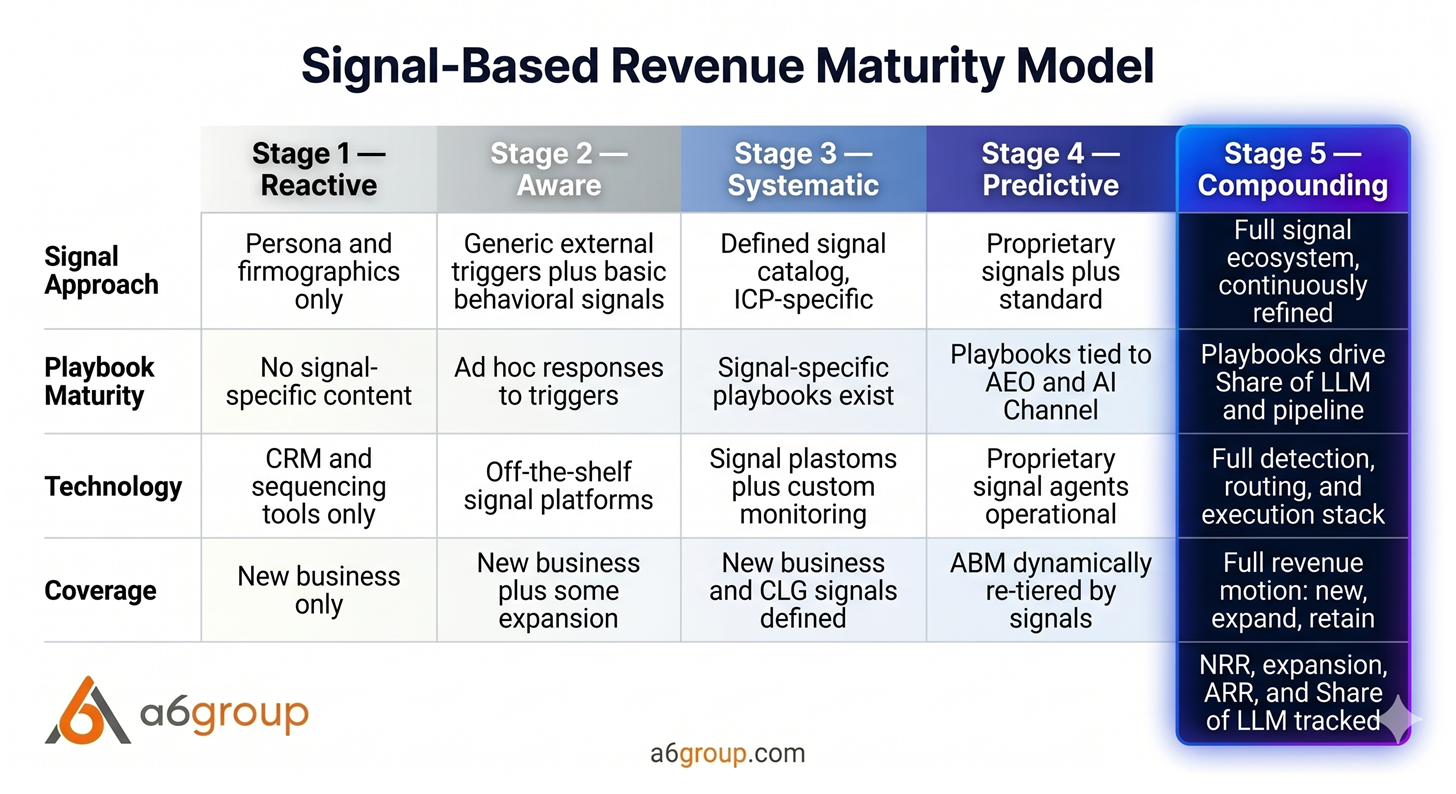
The Signal-Based Revenue Maturity Model
As with any operating model shift, Signal-Based Revenue Systems are built incrementally. The following maturity model helps revenue leaders assess where they are and what to build next.
| Dimension |
Stage 1
Reactive
|
Stage 2
Aware
|
Stage 3
Aligned
|
Stage 4
Predictive
|
Stage 5
Orchestrated
|
|---|---|---|---|---|---|
| Signal approach | Persona and firmographics only | Generic external triggers plus basic behavioral signals | Defined signal catalog, ICP-specific | Proprietary signals plus standard | Full signal ecosystem, continuously refined |
| Playbook maturity | No signal-specific content | Ad hoc responses to triggers | Signal-specific playbooks exist | Playbooks tied to AEO and AI Channel | Playbooks drive Share of LLM and pipeline |
| Technology | CRM and sequencing tools only | Off-the-shelf signal platforms | Signal platforms plus custom monitoring | Proprietary signal agents operational | Full detection, routing, and execution stack |
| Coverage | New business only | New business plus some expansion | New business and CLG signals defined | ABM dynamically re-tiered by signals | Full revenue motion: new, expand, retain |
| Measurement | Activity metrics | Signal volume and response rates | Conversion by signal type | Pipeline and revenue by signal source | NRR, expansion ARR, and Share of LLM tracked |
Most revenue teams sit at Stage 1 or 2. They have access to signal platforms but are using default triggers pointed at generic ICP criteria. The jump from Stage 2 to Stage 3 is the most important one — it requires the signal catalog exercise and the commitment to build playbooks that match. Everything after that is refinement and scale.
Self-assessment prompt: Pull your last twenty closed-won deals. What was happening inside those accounts in the ninety days before they engaged you? If you cannot answer that question with specificity, you are at Stage 1 regardless of what platforms you have running.
Building the Capability: A Practical Roadmap
Phase 1 — Signal Catalog and Playbook Foundation
Months 1–3
The starting point is the retrospective analysis described above. Bring together sales, marketing, and RevOps and map the business events that preceded your best deals. Define your tier-one signals — the triggers most strongly correlated with buying readiness for your ICP. Define your tier-two signals — useful but lower-confidence triggers that warrant monitoring without immediate action.
For each tier-one signal, build a corresponding playbook. Define who owns the outreach, what the opening message looks like, what content supports the conversation, and what questions surface the pain the signal represents. Pilot the playbooks on a defined set of target accounts before scaling.
Phase 2 — Detection Infrastructure
Months 2–6
With the signal catalog defined, audit your existing technology stack for signal detection capability. Identify the gaps between the signals you have defined and what your current tools surface. For standard signals, configure existing platforms to monitor what your catalog defines rather than defaults. For proprietary signals, scope the custom monitoring capability needed and prioritize by expected impact.
This is also when to establish the RevOps function as the operational owner of the signal system — the team responsible for signal catalog governance, playbook maintenance, and performance measurement.
Phase 3 — Expansion and ABM Integration
Months 4–9
Extend the signal catalog to existing accounts. Define the internal signals that indicate expansion potential or churn risk within your customer base. Connect signal detection to your CSM workflow so that expansion triggers reach the right person with the right context in time to act.
Integrate signal data into your ABM program. Establish a re-tiering protocol that elevates accounts when relevant signals fire and deprioritizes accounts with no signal activity. Review and update account tiers monthly rather than quarterly.
Phase 4 — AEO and AI Channel Alignment
Months 6–12
Audit your playbook content for AEO readiness. Identify the queries your buyers are asking AI systems when your tier-one signals fire. Map your existing playbooks against those queries and identify gaps. Build or restructure content to optimize for Share of LLM on the questions that matter most for each signal context.
This phase connects Signal-Based Revenue Systems to the broader AI Demand Channel strategy — ensuring that the playbooks driving outbound conversations are also building presence and authority in the AI-mediated buying journey.
Measuring What Matters
A Signal-Based Revenue System produces measurable outcomes at every stage. The metrics that matter most:
Pipeline metrics: Conversion rate by signal type. This tells you which signals are producing qualified pipeline and which are generating activity without results. Track separately for new business and expansion.
Velocity metrics: Sales cycle length for signal-triggered deals versus non-signal deals. Signal-based outreach consistently produces shorter cycles because it starts from a position of relevance rather than cold interruption.
Expansion metrics: NRR contribution from signal-triggered expansion plays. This connects the signal system directly to the CLG motion and gives the CCO a revenue metric tied to signal coverage of the existing base.
AI Channel metrics: Share of LLM for playbook-aligned queries. Track whether your content is appearing in AI-generated answers for the questions your buyers ask when tier-one signals fire.
Conclusion: The Revenue Infrastructure Underneath Everything Else
Signal-Based Revenue Systems are not a replacement for demand generation, ABM, or Customer-Led Growth. They are the operational layer that makes all three more effective by ensuring that outreach — to new prospects and existing accounts alike — is timed to moments that matter rather than calendar schedules and demographic profiles.
The teams that build this capability now are building a structural advantage that compounds. The signal catalog gets sharper as you validate which triggers actually convert. The playbooks get more authoritative as they accumulate real-world credibility and AEO traction. The competitive moat widens as proprietary signal agents surface opportunities that off-the-shelf platforms miss entirely.
The alternative — continuing to optimize persona-based outbound and hoping response rates recover — is not a strategy. It is just delaying the inevitable and letting competitors pull ahead.
The buying environment has changed. Buyers are harder to reach, faster to filter, and more likely to complete significant portions of their evaluation through AI systems before a human conversation begins. That journey increasingly runs through the AI Demand Channel. The revenue teams that adapt to that reality — by building systems that are relevant, timely, and credible at the moment a real business event creates a real buying window — will run a fundamentally different kind of go-to-market.
Volume was the game. Timing is the advantage.
Ready to build your signal catalog and assess where your revenue system stands?
A6 Group works with VP Sales, VP Marketing, RevOps, and CRO leadership teams to design and implement Signal-Based Revenue Systems — from signal catalog development through playbook creation, technology stack design, and AI Channel integration. Reach out to start the conversation.