
GTM frameworks assume the customer journey ends at Closed Won. It doesn’t.
Customers continue researching, evaluating, comparing, troubleshooting, expanding, and defending renewal decisions through the exact same AI systems they used before they bought.
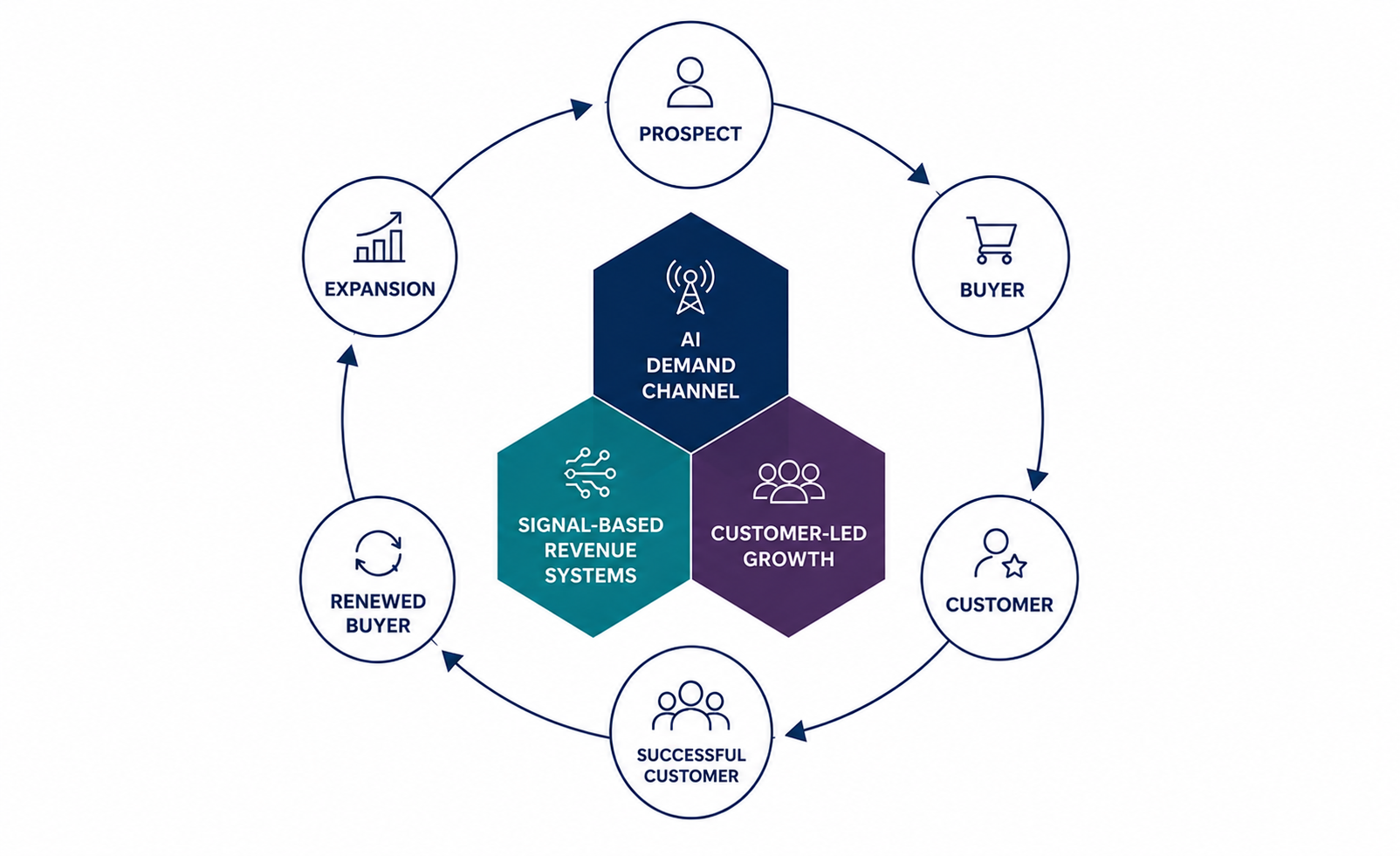
That’s why the AI Demand Channel, Signal-Based Revenue Systems, and Customer-Led Growth are not separate ideas.
They’re one operating system, viewed from three different angles.
This post is about what that operating system looks like, and what changes when you build your go-to-market operating model around it instead of around your org chart.
The Journey Is a Loop
The funnel model assumes one direction: awareness to consideration, consideration to decision, decision to a closed deal that hands off to a different team. It made sense when B2B buying was slow, linear, and vendor-controlled. AI broke that model for a simple reason.
A buyer researching vendors, a customer troubleshooting an implementation, and an economic buyer at an existing account scoping expansion are frequently asking AI systems the same category of question. Each is a different point on the same loop.
The same technical documentation that helps a prospect evaluate compliance fit is what a customer reads eighteen months later scoping an expansion with the same requirements. A merger, a leadership change, a major event: these matter whether you’re selling to the account or servicing it. Your org chart draws a hard line at Closed Won. The account’s actual AI customer journey never does.
Organizing go-to-market around three cleanly separated stages (acquire, deploy, retain) builds the exact structural blindness this operating model is meant to eliminate.
AI Discoverability Doesn’t Stop at the Sale
Buyers and customers increasingly ask the same AI systems similar questions.
That means the same documentation, comparisons, implementation guides, and technical content serve both audiences.
If Marketing owns AI discoverability while Support owns knowledge content, you have already fragmented the channel.
A customer asking an AI assistant how to consolidate content management across two divisions after an acquisition isn’t asking a discovery-stage question. They already own your product. They’re using the identical AI buying journey infrastructure a prospect would use to evaluate whether to buy it in the first place. That’s the post-sales dark funnel, and it runs on the same rails as the pre-sales version.
Content that earns citation when a prospect is evaluating category fit is frequently the same content that earns citation when a customer is troubleshooting a workflow. Split AI search optimization and knowledge base ownership across two teams with two sets of priorities, and you get duplicated effort and inconsistent answers to what is often the identical question.
The AI Demand Channel doesn’t end at Closed Won. AI systems don’t distinguish between a buyer and a customer asking a “how do I” question. Your presence is either coherent across the full account lifecycle, or it isn’t reliably present at all.
A Signal Doesn’t Know Which Side of the Sale You’re On
A business signal doesn’t know whether the account attached to it is a prospect or a customer. A merger, an acquisition, a leadership promotion, a product roadshow, an internal reorganization: these are business events that create buying windows. Whether the window is a new-logo opportunity or an expansion opportunity depends entirely on whether you already have a relationship with the account, not on anything about the signal itself.
Most companies structure detection as if this weren’t true. Sales owns external signal monitoring, pointed at the prospect universe. Customer Success owns internal signal monitoring, pointed at the existing base. Built, staffed, and measured separately, so the moment they’d be most valuable together (an external signal firing on an account you already own) routinely falls into the gap between them.
The fix is one signal catalog covering both external and internal triggers, monitored by shared infrastructure, routed based on whether the account is currently a prospect or a customer. That routing decision depends on relationship status, not on anything about the signal.
This is also why signal-based selling, watching for a trigger and firing outreach when it fires, is a subset of a Signal-Based Revenue System rather than the whole thing. Selling only covers the acquisition half of the loop. A full system covers the entire account lifecycle, because the signals never stopped being relevant just because a deal closed.
Continuity Is the Point of CLG
CLG isn’t fundamentally about expansion.
It’s about preserving continuity of value.
Every function should inherit the same definition of success rather than inventing its own.
Marketing and sales sell a specific value proposition. Onboarding inherits it, often without having been in the room when it was made. Support inherits from onboarding, with its own definition of success (ticket resolution, not business outcome). Customer Success inherits from support, measured on NPS and NRR, not on whether the original value proposition was ever realized. Each handoff is a chance for the value story to degrade or disappear.
A Customer-Led Growth framework treats that as unacceptable. Value gets defined once, communicated consistently, and tracked continuously across every function that touches the account. Expansion, in a mature CLG model, is what happens naturally when value has been tracked continuously and a signal creates the right moment for the conversation. Signal-based expansion is how you operationalize CLG day to day.
The Account Has One Memory. Companies Have Many.
Marketing remembers campaigns.
Sales remembers opportunities.
Support remembers tickets.
CS remembers health scores.
Finance remembers invoices.
The customer remembers one relationship.
Every internal handoff creates a new system of record and a fresh chance to lose context the account already gave you once. The account doesn’t experience five departments with five memories. It experiences one company that either remembers what it told you or doesn’t.
A revenue operating model built around the account’s actual experience treats memory as a shared asset: one value definition, one signal catalog, one content strategy an AI system can draw from consistently, regardless of which internal system happens to own the account this quarter.
Why Now?
This is an old problem AI just made impossible to ignore.
AI has removed the distinction between pre-sales research and post-sales self-service. The same tools, the same query patterns, the same expectation of an instant, synthesized answer apply on both sides of the sale.
Buying committees revisit evaluation continuously, not every three to five years. A renewal is a re-evaluation now, often run through the same AI systems that shortlisted you the first time.
Expansion is increasingly driven by external business signals rather than scheduled QBRs. The account doesn’t wait for your calendar to change.
Every account now exists inside a continuous AI-mediated information environment, whether you designed for that or not. The only choice left is whether your presence in that environment is coherent or fragmented.
The Winners Won’t Have the Best Tools
The customer never reorganizes their experience around your org chart.
They simply keep trying to solve the next problem.
Companies that build separate AI strategies, signal strategies, and customer strategies are optimizing three different internal systems for what the customer experiences as one continuous relationship.
The winners will be the companies that build one go-to-market operating model around one continuous account journey, not the ones with the best individual tools.