AI sales chatbots are becoming an important part of the B2B buying experience. But how well do they actually help buyers evaluate software?
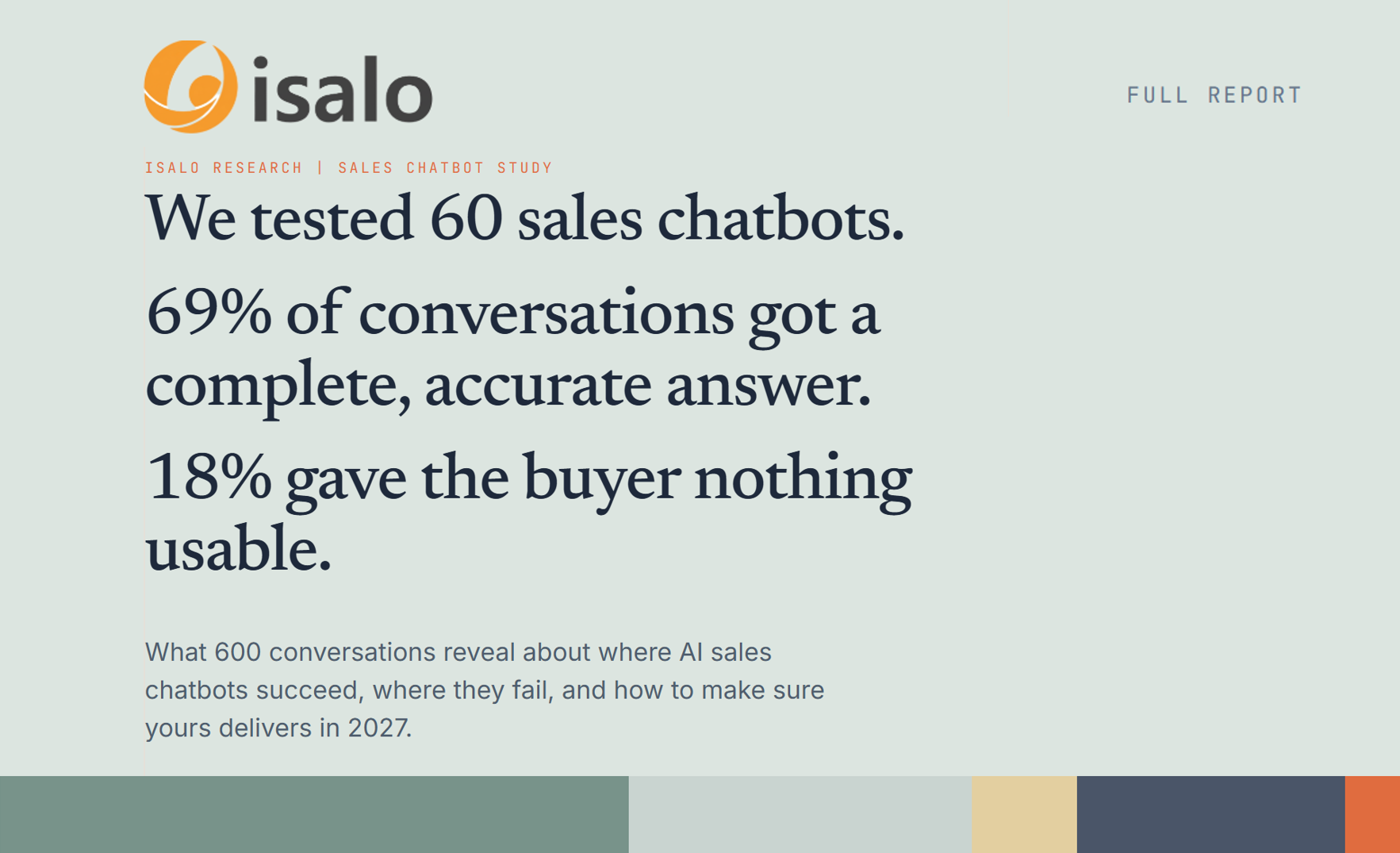
According to isalo’s 2026 AI Sales Chatbot Performance Study, which tested 60 B2B software vendors across 600 buyer conversations, 69% of conversations produced complete, accurate answers, while 18% left buyers with nothing usable.
Another finding raises questions about how B2B companies deploy these systems: 43% of conversations included a request for contact details in the chatbot’s first reply.
For marketing and revenue leaders, the findings expose a tension between two objectives: capturing leads and helping buyers make informed purchasing decisions.
How Were the AI Sales Chatbots Tested?
Between October 30 and November 6, 2026, isalo evaluated AI sales chatbots operating on the marketing websites of 60 B2B software companies.
An AI agent acted as a prospective buyer researching vendors before creating a shortlist. Each chatbot received ten questions covering five common evaluation topics:
-
Compliance: SOC 2 certification and EU data residency.
-
Pricing: Pricing models and monthly versus annual billing.
-
Competition: Competitive differentiation and where competing products might be stronger.
-
Integrations: Support for an existing integration and a fictitious system.
-
Onboarding: Implementation timelines and data migration.
The researchers evaluated whether each answer was complete, accurate, and useful to the buyer. They also examined conversational behavior, lead capture, and consistency across related questions.
The research tested company-operated sales chatbots, not public AI assistants such as ChatGPT, Claude, or Gemini.
The full methodology, scoring criteria, and examples are available in isalo’s original sales chatbot research.
How Accurately Do AI Sales Chatbots Answer Buyer Questions?
Across 600 conversations, the results were mixed:
-
69% produced a complete, accurate answer.
-
12% produced a useful but incomplete answer.
-
1% produced a complete answer that was too generic to use.
-
18% left the buyer with nothing usable.
Performance varied substantially by topic.
| Buyer question category | Complete, accurate answers |
|---|---|
| Integrations | 87% |
| Competition | 82% |
| Onboarding and migration | 69% |
| Pricing | 63% |
| Compliance | 46% |
Compliance was the weakest category, while integrations performed best.
But even these averages conceal important differences.
For example, 83% of chatbots correctly explained what their pricing was based on. Only 43% correctly answered whether monthly billing was available.
The distinction matters. A buyer may appreciate an explanation of a vendor’s pricing model, but whether monthly billing is available could determine whether the product meets the buyer’s purchasing requirements.
The study also found that only 20 of the 60 chatbots provided useful answers to all ten questions.
In 21% of pairs of related questions, the same chatbot provided a useful answer to one question but not the other.
A chatbot that performs well on one scenario cannot be assumed to perform equally well on the next.
Why Do AI Sales Chatbots Fail to Answer Questions?
The study identified several recurring problems.
Missing or inaccessible source information
When a vendor’s pricing page explicitly stated its billing terms, 73% of chatbots provided a complete, accurate answer to the monthly-versus-annual billing question.
When the page was silent, only 21% did.
That suggests published information is an important contributor to chatbot performance.
However, publishing the answer is not sufficient.
Even when billing terms were clearly available on the pricing page, 27% of chatbots failed to provide a complete, accurate answer.
This is particularly relevant to companies investing in content for SEO and Answer Engine Optimization (AEO). Accurate, accessible source content is necessary, but companies must also verify how their AI systems interpret and present that information.
Misunderstanding buyer intent
Some chatbots misunderstood straightforward questions.
One vendor’s chatbot interpreted a question about customer onboarding as a question about its own employee onboarding process.
Others repeated canned responses, provided unrelated information, or failed to respond appropriately when the buyer clarified the question.
Sales workflows interrupting the conversation
Some chatbots quickly redirected buyers toward contact forms, demos, or sales representatives rather than answering the question.
A handoff may be appropriate when the buyer needs customized information. But when the answer is already available, forcing a sales interaction introduces unnecessary friction.
These problems suggest that testing chatbot functionality alone is insufficient. Companies need to evaluate whether the buyer can actually accomplish the intended task.
Are AI Sales Chatbots Too Focused on Lead Capture?
Lead capture was a prominent feature of the conversations tested by isalo.
-
67% included a request for contact information or an offer of a meeting.
-
43% included a request for contact details in the first reply.
-
14% asked for contact information before providing any answer.
-
33% included an offer of a meeting, demo, or call.
There is nothing inherently wrong with asking for contact information.
A prospect requesting a custom quote, detailed security review, or technical consultation may benefit from speaking with a sales representative.
But a buyer asking whether a product supports monthly billing may simply be trying to determine whether the vendor belongs on a shortlist.
The research found that chatbots answering first and requesting contact details afterward generally produced more complete answers than those requesting contact information before answering.
These are observational findings, not proof that early lead capture causes poor chatbot performance or reduces conversions.
Nevertheless, they raise an important question:
Are B2B companies optimizing their chatbots to capture leads, or to help buyers evaluate their products?
What These Results Mean for B2B Marketing and Revenue Leaders
The findings have implications beyond chatbot configuration.
They expose three broader issues in how companies design and measure digital buying experiences.
1. Lead capture and buyer enablement are different objectives
B2B marketing has historically focused on converting anonymous website visitors into identifiable leads.
That made sense when buyers depended heavily on vendor interactions to obtain detailed product information.
Today, prospects can research products through vendor websites, public AI assistants, review platforms, communities, and other sources before contacting Sales.
A chatbot that immediately requests an email address may be operating exactly as its marketing team intended.
But that does not establish whether it helped the buyer.
A company could report strong chatbot engagement and lead capture while remaining unaware that prospects are receiving incomplete answers to important evaluation questions.
Marketing leaders should therefore measure two outcomes separately:
-
Commercial outcomes: Qualified leads, meetings, pipeline, and revenue.
-
Buyer experience outcomes: Whether prospects obtain accurate information, resolve questions, and progress through their evaluation.
Both matter. Neither is a reliable substitute for the other.
2. AI chatbot performance depends on content and conversational intelligence.
The pricing results illustrate an important point: publishing accurate information is necessary, but it doesn’t guarantee that chatbots will use it correctly. Companies need to test not only what they publish, but how AI systems interpret and communicate that information.
But content is only part of the equation.
Sales chatbots are evolving from basic question-answering tools into AI Sales Development Representatives (AI SDRs). More sophisticated platforms can leverage sales playbooks, qualification frameworks, and conversational context to ask relevant questions, understand buyer needs, and guide prospects through an evaluation.
We suspect some of the strongest-performing chatbots in the isalo study may have benefited from these more advanced capabilities. However, the research did not establish which capabilities were enabled in each implementation, so we cannot attribute performance differences to specific technologies.
One finding makes this particularly interesting: only 6% of conversations involved a chatbot asking about the buyer’s situation and using the answer to tailor its response.
For B2B companies, the challenge is increasingly twofold: make accurate information available to AI systems, and equip those systems to engage buyers intelligently. Both require continuous testing.
3. Outside-in testing reveals problems internal dashboards miss
Most organizations measure digital experiences through systems they operate.
Marketing automation tracks engagement. CRM tracks leads and opportunities. Chatbot analytics track conversations, deflection, and handoffs.
These metrics are useful, but they do not necessarily reveal whether a buyer received the information needed to make a decision.
Consider a prospect asking whether a software product supports EU data residency.
The chatbot might record a completed interaction, provide a link to the security page, or successfully route the visitor to Sales.
Yet the prospect may still be unable to determine whether EU hosting is available, whether it is the default, or what conditions apply.
From the organization’s perspective, the interaction may look successful.
From the buyer’s perspective, the question remains unanswered.
That is why organizations should test buyer experiences from the outside in, using realistic scenarios and evaluating whether the buyer accomplishes the intended goal.
What Do the Best AI Sales Chatbots Do Differently?
The strongest implementations in isalo’s research demonstrated several behaviors worth adopting.
Answer first, then ask for contact information. Effective chatbots provided available information before suggesting a relevant sales interaction.
Ask questions that improve the answer. Only 6% of conversations included a question about the buyer’s situation before answering and then used the response to tailor the answer.
Be candid about competitive limitations. Some chatbots identified specific situations where a competitor might be a better fit.
Acknowledge uncertainty. None of the 60 chatbots invented a native integration with the fictitious HR system used in the research. However, four gave weakly hedged responses rather than clearly explaining what they could confirm.
Maintain conversational context. Useful chatbots responded to clarifications and follow-up questions rather than repeating generic marketing messages.
Only 3% of conversations combined asking about the buyer’s situation, tailoring the answer, and suggesting a relevant next step.
The opportunity is substantial: move beyond chatbots that simply retrieve information or collect leads toward systems that help buyers conduct meaningful product evaluations.
Does the Chatbot Platform Determine Performance?
The study found a significant performance difference between the two chatbot platforms represented in its sample.
Chatbots on one platform produced useful answers in 90% of conversations, compared with 58% for the other.
That is a substantial difference, but it should not be interpreted as proof that one platform’s underlying technology is inherently superior.
The sample included 44 chatbots on one platform and 16 on the other. Differences in vendor implementation, source content, configuration, and sales workflows may have contributed to the results.
Platform selection matters, but companies should also evaluate the quality of their own implementations.
A strong platform does not eliminate the need for accurate content, appropriate configuration, and ongoing testing.
How Should B2B Companies Test Their Sales Chatbots?
The research suggests five practical priorities.
1. Start with realistic buyer scenarios.
Test the questions prospects ask when evaluating products, including pricing, compliance, competition, integrations, and onboarding.
2. Compare chatbot answers with authoritative sources.
Verify that responses accurately reflect published product information, pricing terms, security documentation, and other trusted content.
3. Evaluate complete conversations.
Test follow-up questions, clarifications, requests for contact information, and situations where buyers decline to share personal details.
4. Measure buyer success separately from lead capture.
A completed conversation, captured email address, or scheduled meeting does not establish that the buyer received a useful answer.
5. Test continuously across channels.
Products, pricing, policies, and website content change. Chatbot performance can change with them.
And buyers do not limit their research to a company’s own chatbot.
They also use search engines, public AI assistants, documentation, review platforms, and communities.
A broader Buyer Experience Optimization approach evaluates whether buyers receive accurate, consistent, useful information across these channels.
The sales chatbot study measured vendor-operated chatbots specifically. Testing the broader buying journey requires additional scenarios and channels.
Frequently Asked Questions
How accurate are AI sales chatbots?
According to isalo’s November 2026 study of 60 B2B software sales chatbots, 69% of 600 conversations produced complete, accurate answers. Another 12% produced useful but incomplete answers, while 18% left buyers with nothing usable.
Which buyer questions are hardest for AI sales chatbots?
Compliance questions had the lowest overall complete-answer rate at 46%. The single hardest question concerned monthly versus annual billing, which received a complete, accurate answer in only 43% of conversations.
Do AI sales chatbots ask for contact information too early?
In isalo’s study, 43% of conversations included a request for contact information in the chatbot’s first reply. In 14%, the chatbot requested contact details before providing an answer. Whether that behavior is too early depends on the buyer’s question and the purpose of the interaction.
Can AI sales chatbots answer questions about competitors?
Yes. Competitive questions received complete, accurate answers in 82% of conversations. Some chatbots also identified specific situations where competing products might be a better fit.
Does publishing accurate website content improve chatbot performance?
The study found an association between published pricing information and answer quality. When pricing pages stated billing terms, 73% of chatbots answered the relevant question completely and accurately, compared with 21% when the pages were silent. However, 27% still missed an answer that was published.
How can companies improve AI sales chatbot performance?
Companies should publish accurate buyer-facing information, verify that chatbots use it correctly, test realistic buying scenarios, improve conversational behavior, and measure whether buyers receive useful answers. Continuous testing helps identify problems as content and implementations change.
Read the Full AI Sales Chatbot Research
The results show that AI sales chatbots can help prospects evaluate B2B software, but performance remains inconsistent.
Some chatbots provided useful answers to every question. Others struggled with basic pricing and compliance questions, repeated irrelevant responses, or redirected buyers toward Sales without resolving their questions.
For marketing and revenue leaders, the lesson is straightforward: a chatbot’s success should be measured by what buyers accomplish, not simply by what the system records.
The full isalo AI Sales Chatbot Performance Study includes detailed benchmarks, anonymized conversations, implementation recommendations, and a practical checklist for evaluating your own chatbot.
Original research source: isalo, How Good Are B2B Sales Chatbots? Results from 600 Buyer Conversations, published November 12, 2026. Research conducted October 30 to November 6, 2026.