These aren’t white papers written to generate leads. They’re the operating frameworks A6 Group uses to diagnose problems, structure engagements, and guide execution across the revenue lifecycle. We publish them because we think they’re useful — and because the best clients are the ones who’ve already done the thinking.
Each framework below links to a full reference guide. Where relevant, we’ve also linked to the Substack articles and blog posts where the arguments were first developed.
FRAMEWORKS
CLG Framework: Building a Customer-Led Growth System
Customer-Led Growth is the discipline of turning your existing customer base into a reliable, measurable growth engine — anchored in NRR rather than acquisition metrics, and built around customer value rather than customer satisfaction.
The CLG Framework covers the five stages of CLG maturity, the measurement model that separates value from satisfaction, the operating infrastructure required at each stage, and the governance model for scaling CLG as a company-wide motion.
Key concepts: Customer Value Journey, Proactive Success, Predictive Customer Health, Ambient Sensing, Experience Yield, NRR, CLG Council
The AI Demand Channel is the full commercial journey through which B2B buyers discover, evaluate, and engage with vendors via AI systems — from the first AI-generated answer that surfaces a vendor name through to the buying decision. AEO (Answer Engine Optimization) is the top-of-funnel entry point, but the AI Demand Channel is the full architecture.
This framework covers how buyers are using AI in the purchase journey, what it takes to build presence in AI-generated answers, how to measure Share of LLM, and how to connect AI discovery to downstream revenue programs.
Key concepts: AI Discovery Channel, AI Demand Channel, AEO, Share of LLM, LLM visibility, intent-based demand
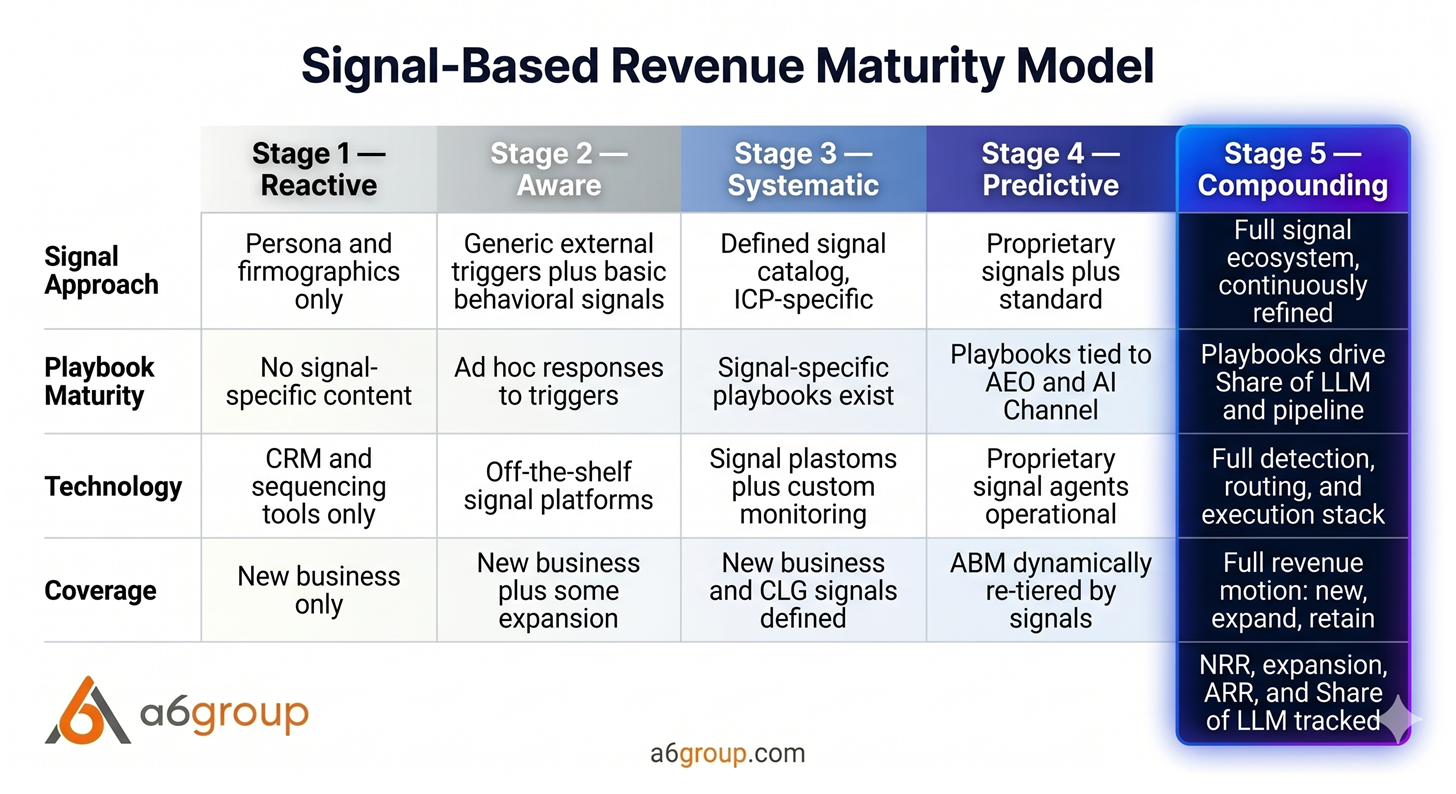
Signal-based revenue systems replace persona-based outbound logic with intent-driven operating models — built around the behavioral, firmographic, and engagement signals that tell you when a specific account is in motion, and the playbooks that tell your team what to do when they are.
This framework covers the signal architecture required to build a reliable signal-based motion, the five-stage maturity model for signal-based selling, the tool landscape and platform selection logic, and the operating model that connects signal capture to pipeline generation.
Key concepts: Signal-Based Selling, Buying Signal Detection, Signal Architecture, Ambient Sensing, Playbook-Driven Outreach, Pipeline Intelligence
Looking for a framework applied to your specific situation?
These guides are a starting point. The application is always specific to your market, motion, and maturity stage. Contact us if you want to think through how any of these frameworks apply to your revenue architecture.