
A customer can be perfectly healthy and still never buy anything else from you. A customer can be at risk of churning and still have a major expansion opportunity sitting untouched in a different part of the business.
That is not a edge case, but the normal state of most enterprise accounts. And it exposes a structural problem that most CS organizations have not fully confronted: retention and growth are not opposite ends of the same spectrum. They are separate systems, requiring separate signals, separate plays, and separate organizational capabilities. Most CS teams are running one of them and calling it both.
The new pressure on CS
CS organizations are increasingly reporting to the CRO. That shift is not cosmetic. It signals a change in what CS is expected to deliver: not just protected revenue, but new revenue from the existing base. Expansion from existing customers has become a top priority in most B2B revenue models, for straightforward reasons. Acquisition costs are rising. New logo pipeline is getting harder and more expensive to build. The existing customer base represents the most capital-efficient growth opportunity most companies have.
The problem is that the mandate has changed faster than the operating model. CS teams built to reduce churn are now being asked to drive growth with the same headcount, the same tools, the same plays, and the same QBR calendar. The intent is right. The infrastructure is not there.
How NRR became a trap
The historical CS relationship with NRR was essentially defensive: compensate for churn and downsell with enough upsell and expansion to keep the number healthy. A team that retains 95% of revenue and expands 5% hits a 100% NRR target. That looks fine on a dashboard. It does not mean the team is building a growth engine. It means they are running fast enough to stay in place.
Customer-Led Growth reframes NRR as a genuine revenue growth objective: expansion that goes beyond compensating for contraction and starts compounding across the base. The distinction matters because it changes what you build, what you measure, and who owns what. Hitting an NRR target by offsetting losses is a retention achievement. Growing NRR consistently over time is a growth achievement. Most CS organizations have been rewarded for the first and are now being asked to deliver the second, without rebuilding anything to make that possible.
The conflation problem
The most common response to the “drive more expansion” mandate is to add expansion goals to existing CS roles. Same team, same plays, the same QBR format, the same health scores, with an upsell conversation appended to the renewal discussion. Sometimes a spiff is added. Occasionally a playbook is written. The underlying system does not change.
This produces predictable results. CSMs who are skilled at retention conversations feel awkward in commercial ones. Health scores designed to flag at-risk accounts do not surface expansion opportunities. QBR agendas built around relationship maintenance do not naturally surface new buying centers. Expansion becomes dependent on the customer raising their hand rather than the vendor identifying the opportunity proactively.
Growth does not come from doing retention better. It requires building something structurally different alongside it.
What retention actually is
Retention is a defensive motion. Its job is to remove the reasons a customer might leave.
The signals that drive it are risk indicators: declining product usage, rising support ticket volume, an executive sponsor departure, a dissatisfied response in the last NPS pulse, a competitor starting to appear in account conversations. The metrics that matter are lagging indicators of health — renewal rate, churn rate, NPS, CSAT. The organizational instinct is reactive: find the problem, fix the problem, protect the contract.
Done well, retention is genuinely valuable. A CS organization that catches at-risk accounts early, resolves issues before they escalate, and maintains healthy relationships across a large customer base is doing something important. It is just not driving growth. It is preventing loss. Those are different jobs.
What growth in the existing base actually is
Growth is an offensive motion. Its job is to find and act on expansion opportunities before the customer thinks to ask.
The signals that drive it are value indicators: product adoption patterns that suggest readiness for the next use case, power users spreading to new teams within the account, feature usage hitting the ceiling of the current tier, a new business initiative that maps to your capabilities, hiring activity in a function your product serves. The metrics that matter are forward-looking — expansion pipeline, NRR trending upward over time, time-to-expand from signal to close, expansion conversion rate.
The organizational instinct is proactive: find the opportunity, build the case, bring it to the right stakeholder before procurement gets involved and before the customer has framed it as a purchase decision. This is Customer-Led Growth operating as a revenue motion, not a service motion. The skills required, the plays involved, and the timing logic are different from anything in the retention playbook.
Why the signals are different
Retention signals and growth signals are not variations of the same data. They are structurally different indicators requiring different detection infrastructure, different interpretation logic, and different response plays.
A signal-based system configured to flag at-risk accounts looks for things going wrong: usage drops, sentiment shifts, relationship gaps, competitive noise. A signal system configured to surface expansion-ready accounts looks for things going right in commercially relevant ways: adoption spreading, usage ceiling approaching, organizational change creating new demand.
To make the distinction concrete:
- Retention signals include login frequency dropping across key users, support ticket volume rising without resolution, an executive sponsor leaving the account, NPS declining in the last pulse survey, or a competitor appearing in renewal conversations.
- Growth signals include power user adoption spreading to a new department, feature usage consistently hitting tier limits, a new VP joining an account with a different set of priorities, the account announcing an acquisition or market expansion, a new internal initiative that maps directly to a use case your product supports.
Both sets of signals matter. Neither substitutes for the other. A single health score trying to capture both will inevitably compress the information that makes each one actionable.
Why more QBRs will not create growth
There is a broadly held assumption in CS that better customer relationships produce more expansion. Build the relationship, earn the trust, and the growth follows. It is not wrong exactly. It is incomplete in a way that costs real revenue.
You can spend hundreds of hours in customer meetings and still miss the fact that they just acquired a company, hired a new VP of Operations with a completely different technology agenda, entered a new market that your product is positioned to support, or launched an internal initiative that your competitor is already in conversations about.
QBRs surface what the customer chooses to share, filtered through the perspective of the contacts you already have. Growth signals live in what the customer does not think to mention, in organizational changes that your existing contacts are not tracking, and in commercial opportunities that have not yet been connected to a purchase decision by anyone inside the account.
Growth comes from visibility into customer change. Not from more meetings. The QBR is a relationship tool. It is not a signal system. Treating it as both is why expansion so often depends on the customer raising their hand rather than the vendor identifying the opportunity first.
Buying centers are your source of growth
The contacts who signed the original contract are rarely the ones who will sign the expansion. Serious growth in the existing base — a new business unit adopting the platform, a new function coming on, a geographic rollout — requires reaching a buying center that your current relationships do not cover.
Most CS teams are not built for that. They are built to manage the relationship with the stakeholders who own the existing deployment. That is appropriate for retention. It is a ceiling for growth.
CLG as a growth motion requires a different kind of account intelligence: not just how healthy is this relationship, but where else in this account does a relevant problem exist, who owns it, and what would it take to get a conversation there. Expansion that stays within the existing buying center is incremental. Expansion that reaches a new one is structural. The difference in revenue potential between the two is significant, and most CS organizations are systematically underinvesting in the latter.
The two dimensions CS teams need to manage
Most CS teams look at accounts along a single axis: risk. High risk, low risk, somewhere in between. Health scores, red-yellow-green dashboards, at-risk account lists. That vertical view is necessary. It is not sufficient.
CLG requires adding a second axis: growth potential. Low expansion potential, high expansion potential, and everything in between. When you map accounts across both dimensions, four distinct situations emerge, each requiring a different play.
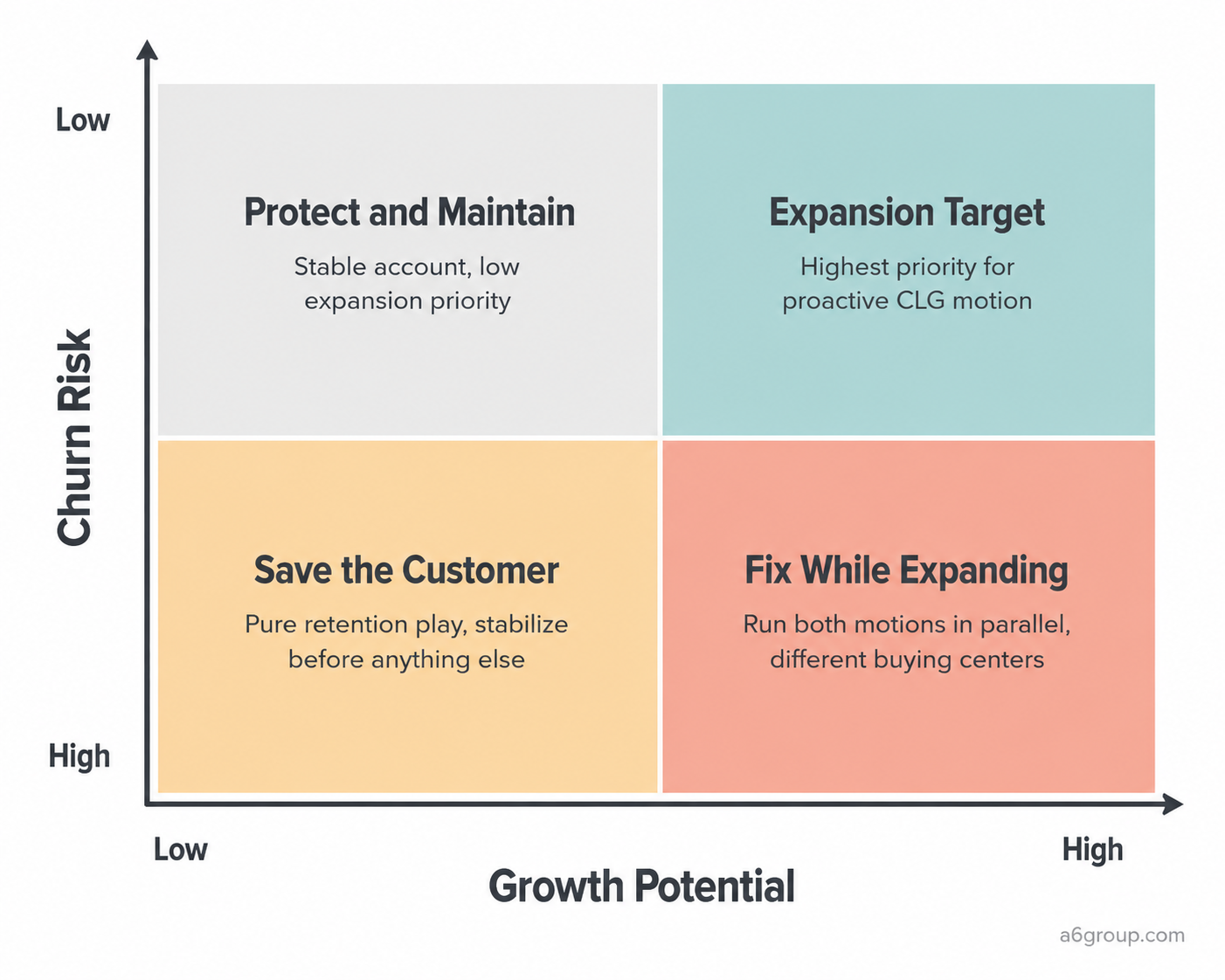
A stable account with low growth potential needs protection and maintenance. It is not a priority for expansion investment. A stable account with high growth potential is the expansion target — the highest priority for a proactive CLG motion, and the account type most CS organizations underserve because it does not generate urgency signals.
An at-risk account with low growth potential is a pure retention play. Save the customer, stabilize the relationship, protect the contract. An at-risk account with high growth potential is the most complex situation in the existing base: the relationship needs fixing and the expansion opportunity needs building, likely with a different buying center than the one generating the risk signal. Both motions have to run in parallel.
The point is not that every account needs a complex strategy. It is that a single health score cannot tell you which of these four situations you are in. Many CS teams only manage the vertical axis. They know which accounts are healthy and which are not. CLG requires managing the horizontal axis too, and building the organizational capability to act differently depending on where an account sits.
The Stage 2 trap
This is precisely why most CS organizations get stuck at Stage 2 of the CLG maturity model. Stage 2 organizations know they should be driving growth from the existing base. They have added expansion to the CS charter. They are measuring NRR. The intent is right.
What they lack is the structural separation that makes growth a repeatable motion rather than an occasional win:
- Distinct signal infrastructure for retention vs. growth.
- Distinct plays with distinct triggers and owners.
- Distinct metrics that measure expansion as a growth achievement, not just a churn offset.
- And in most cases, distinct ownership at the account level: a CLG-focused role or dedicated capacity that is explicitly not responsible for firefighting and therefore available to run proactive expansion plays.
The path from Stage 2 to Stage 3 runs directly through that separation. Not through hiring more CSMs. Not through adding expansion targets to existing roles. Through building the second system alongside the first.
What two distinct capabilities actually look like
The organizational design does not have to be complex to be effective. A few separations matter more than others.
- Separate the signal catalog. Define retention signals and growth signals explicitly, with different sources, different detection logic, and different routing. A usage drop routes to the CSM responsible for the account. A new VP hire at an account routes to whoever owns the expansion motion. Both signals matter. They should not land in the same inbox with the same priority.
- Separate the metrics. Health scores measure retention capability. Expansion pipeline, NRR trending over time, and time-to-expand measure growth capability. Reporting both on the same dashboard without distinguishing them obscures which motion is actually working.
- Separate the plays. Risk response plays and expansion plays have different triggers, different owners, and different timing logic. A risk response play starts with a problem. An expansion play starts with an opportunity. Writing them down as distinct plays with distinct activation criteria is a more valuable investment than most CS teams realize.
- Map the buying centers. For every account above a meaningful revenue threshold, know which buying centers exist beyond your current contacts, who owns them, and what problems they have that your product addresses. That map is the foundation of any serious expansion motion.
- Consider separate ownership at scale. At a certain account volume and revenue level, the retention and growth motions benefit from distinct ownership — a CLG-focused role explicitly chartered for expansion, even if it shares account coverage with the core CS team. The separation does not have to be organizational from day one. It has to be intentional.
A customer who is healthy and not expanding is not a CS success. It is a missed opportunity that the data is not currently set up to surface. Building the system that surfaces it is what separates a CS organization from a Customer-Led Growth engine.