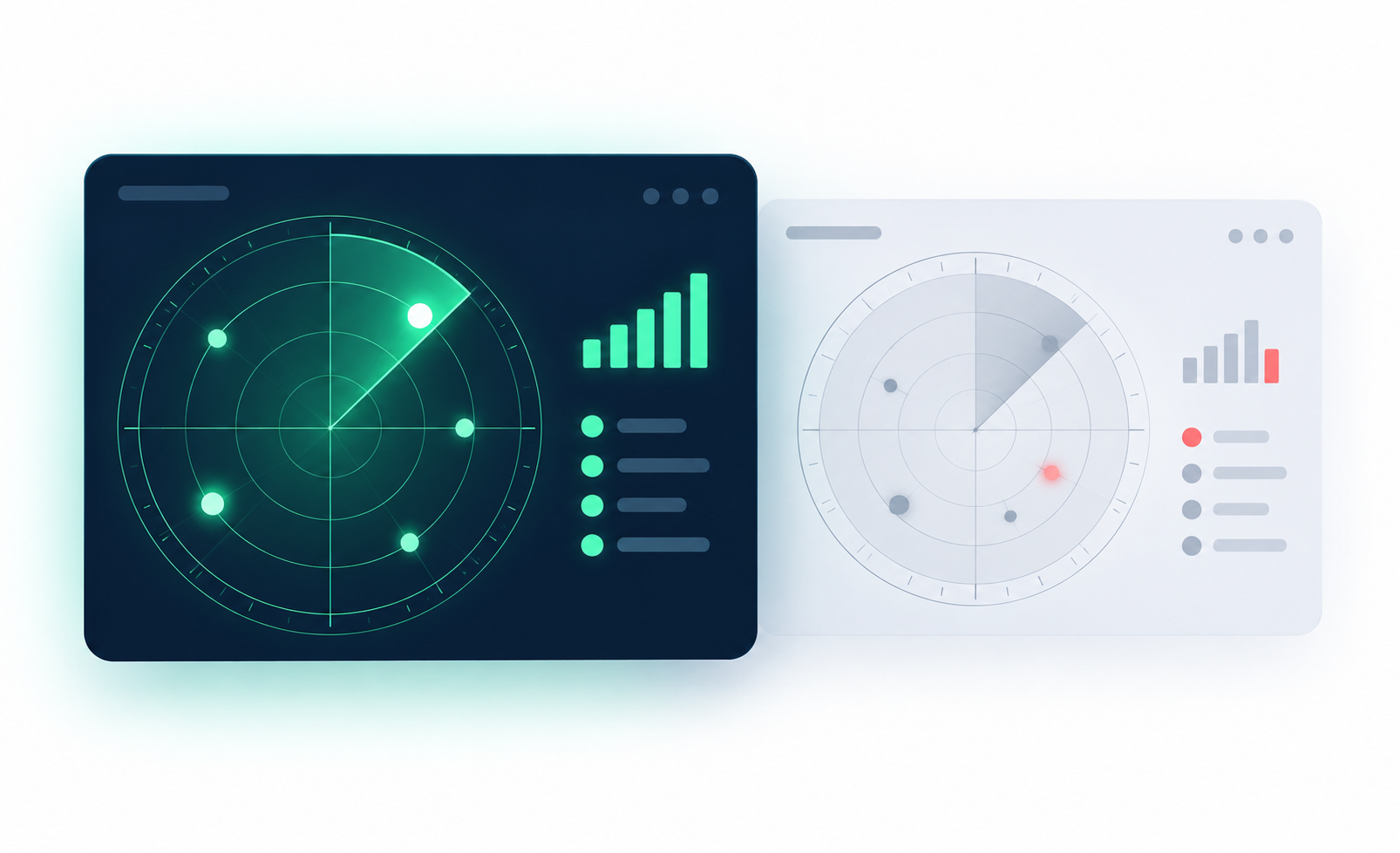
Your Share of LLM is strong. You’re showing up in the answers. The discoverability dashboard is green across the board. And you’re still losing deals to companies with a fraction of your citation volume.
A high Share of LLM paired with poor Citation Accuracy is a comprehension problem hiding behind a visibility win. The model finds you. It just doesn’t understand you.
What does it mean when Share of LLM is high but Citation Accuracy is low?
It means the extraction layer is working and the entity layer isn’t. AI systems are pulling your content into answers often enough that the volume metric looks healthy. But when a prospect asks something more specific, what you actually do, how you’re different from the three vendors also mentioned in the same answer, the model either gets it wrong, gets it generic, or gets it half right in a way that flattens you into the category instead of setting you apart.
This is worse than not showing up. A prospect who never sees you hasn’t formed an opinion yet. A prospect who sees an inaccurate or generic version of you has, and now you’re negotiating against a company that doesn’t exist.
Why does the model get the citation right but the description wrong?
Usually because the entity signals feeding the model are inconsistent, even when the content itself is well optimized for extraction. Your website says one thing. Your LinkedIn company page says something adjacent. A third-party directory or an old press mention says something outdated. YouTube carries older videos that are now disconnected from your current messaging. None of these are wrong exactly, but none of them are aligned with your current “truth,” and the model has no way to resolve the disagreement in your favor. It picks whichever version is best represented across its training sources, which is rarely the version you’d choose.
Extraction optimization and entity accuracy are different problems that happen to look similar on a dashboard. Fixing the first doesn’t touch the second.
What does a Citation Accuracy gap actually cost you in the pipeline?
It shows up at the exact moment a deal should be accelerating, not at the top of the funnel where it’s easy to shrug off. A prospect has already found you. They’re past discovery. They’re working their short list, checking you against alternatives, and this is where an AI-generated description that’s vague, outdated, or wrong silently resets the deal to zero. Sales never sees it happen. There’s no form fill, no bounce, no obvious signal. The prospect just doesn’t contact you, or shows up to the call with a version of your positioning you’d never approve, and now the rep is fighting an argument they didn’t know was happening.
That’s the version of this problem that should worry a RevOps leader more than a marketing dashboard: it’s invisible until it’s already cost you the frame of the conversation.
How do you diagnose a Citation Accuracy gap before it costs a deal?
Run the comparison test across models. Ask ChatGPT, Claude, Gemini, and Copilot to describe your company, and then ask each one how you compare to your top two competitors. Look for three things:
- Whether the core description is consistent across all four.
- Whether it matches how you actually describe yourselves.
- Whether the comparison answer differentiates you or lumps you into a generic category with everyone else.

If the description drifts between models, that’s an entity consistency problem. If it’s consistent but wrong or thin, that’s a source quality problem, meaning the sources the models are pulling from don’t say enough, or don’t say the right thing. Either diagnosis points to a different fix, and neither one gets solved by publishing more citable content, which is the instinct most teams reach for first.
What’s the fix, and how long does it take?
Entity work is slower than citation work, and that’s the part most teams underestimate. Standardizing how your company is described across your own site, LinkedIn, Crunchbase, and any directory listing is step one, and it has to be the same language everywhere, not just similar. It’s also the layer most AI Channel Strategy work focuses on once the initial AEO foundation is already in place. Executive bylines and consistent public commentary from leadership reinforce the same entity signal over time. None of this produces a visible change in a week. It builds over months as training data refreshes catch up to the corrected signal.
The teams that get this right treat Citation Accuracy as a standing metric next to Share of LLM, not a one-time cleanup project. You don’t fix an entity signal once. You keep it consistent as the company changes, because every new positioning shift or product launch reopens the gap if it’s not deliberately closed again.
Visibility gets you into the conversation. Accuracy decides whether the conversation is about the company you actually are.