Most AEO conversations are about visibility. Show up more often. Get cited more. Increase your Share of LLM when someone asks an AI system about your category, products, or competitors.
That makes sense for many demand-generation questions. Customer experience is different.
Ask ChatGPT which vendors in your industry have the worst customer support, which take the longest to deliver value, or which have recurring reliability problems. Showing up prominently in those answers isn’t exactly an AEO win. Being mentioned isn’t inherently good. The context of the mention matters.
This creates a different challenge for companies trying to understand how they are represented across public AI systems: their AI Support Reputation.
What is AI Support Reputation?
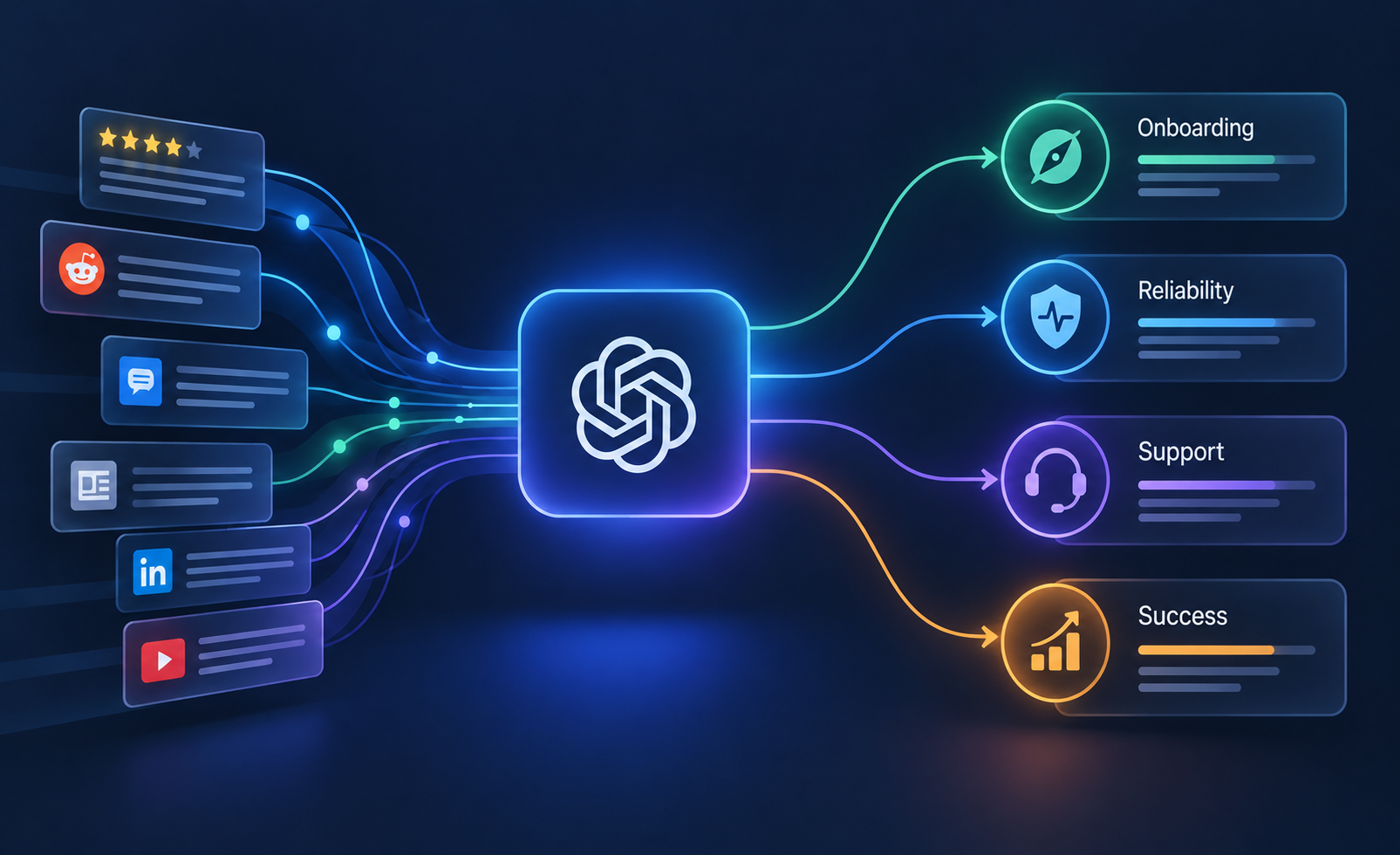
AI Support Reputation is how public AI systems such as ChatGPT, Claude, and Gemini describe the quality of your customer support, onboarding, reliability, and customer success experience.
It’s the version of your post-sales reputation that a prospect or customer gets when they ask AI about you. And that version may not look exactly like the customer experience you’re measuring internally. Your CSAT scores might be strong. Your NPS might be improving. Your renewal rates might be healthy.
Then a prospect asks: “What are the biggest complaints customers have about Company X?”
The answer may surface recurring issues from review sites, community discussions, forums, social posts, and other public sources. Your AI reputation isn’t necessarily the same as the customer reputation you see in your internal metrics.
The four dimensions of AI Support Reputation
There are four areas we think are particularly important to monitor.
Onboarding and professional services
How do AI systems describe the experience of getting started with your product, implementing it, and reaching value?
A prospect might ask:
“Which vendors in this category are easiest to implement?”
Or:
“Which companies have the longest time to first value?”
These questions used to be answered primarily through vendor references, analyst research, review sites, or conversations with sales teams. Now a buyer can ask an LLM before ever contacting you.
Reliability
How do AI systems describe your uptime, service availability, incidents, and ability to meet customer expectations?
A buyer might ask:
“Which vendors in this industry have the worst track record for service availability?”
Or an existing customer might ask about recurring outages or known reliability issues before deciding whether to expand their use of your product. An SLA may tell them what you’ve contractually committed to. AI can tell them what other sources say the actual experience has been.
Customer support
What does AI tell people about the quality, responsiveness, and effectiveness of your support organization?
A prospect might simply ask:
“What do customers say about Company X’s technical support?”
The answer can synthesize information from reviews, community discussions, forums, and other available sources. A critical review or discussion that once had limited reach can now become one of the sources informing an AI-generated answer for someone researching your company.
Customer success
How do AI systems describe the ongoing experience of working with your company after implementation?
Questions might include:
“Are Company X’s CSMs helpful?”
“Does Company X proactively help customers get value from the product?”
“What do customers say about the renewal experience?”
These aren’t just customer questions. A prospect doing due diligence can ask them before becoming a customer. That makes your post-sales experience part of your pre-sales reputation.
Why NPS and CSAT can’t measure your AI reputation
NPS and CSAT measure something important: what customers who respond to your surveys say about their experience. They don’t tell you what public AI systems are telling prospects and customers about that experience.
Those are two different views.
Your surveys are based on feedback you collect directly. AI systems can draw from information distributed across review sites, community discussions, forums, social posts, documentation, news coverage, and other public sources. Someone doesn’t have to respond to your NPS survey for their experience to become part of your public reputation.
And as AI becomes an interface for product research, that public reputation can be summarized and presented directly to the next person asking about you. This creates a new layer between the customer experience you deliver and the reputation future buyers and customers encounter.
Why more AI visibility isn’t always better
Traditional AEO metrics such as Share of LLM tend to make visibility the objective. For many queries, that’s useful. If someone asks for the leading vendors in your category, you probably want to be part of the answer.
AI Support Reputation requires more context. Consider these two questions:
“Which vendors deliver the fastest time to value?”
“Which vendors have the most difficult implementations?”
Being mentioned prominently in the first could be valuable. Being mentioned prominently in the second could be a warning sign. Simply measuring whether your company appears doesn’t tell you enough. You need to understand why you’re appearing, what the AI system is saying about you, which sources are influencing the answer, and whether that answer is accurate.
For customer support and customer success leaders, that’s a very different question from “What’s our Share of LLM?”. The more useful question is:
What is AI telling people about the experience of being our customer?
How to monitor AI Support Reputation
You have to ask.
Test the questions prospects and customers are likely to ask about onboarding, reliability, customer support, and customer success. Run them across multiple public AI systems. Look at the answers, not just whether your company appears.
- Is the information accurate?
- What positive and negative themes keep surfacing?
- Which competitors appear alongside you?
- What sources are being cited?
- Are old incidents or complaints still influencing current answers?
Then repeat the tests. A one-time audit gives you a snapshot. Your AI Support Reputation can change as customers publish new reviews, competitors create new content, incidents occur, old information persists, and AI systems change how they answer the same questions.
Companies already measure what customers tell them about their experience. Now they also need to understand what AI tells everyone else about it.
This is one of the areas isalo continuously tests as part of its Customer Experience Optimization service, monitoring how public AI systems represent your onboarding, reliability, customer support, and customer success experience over time.