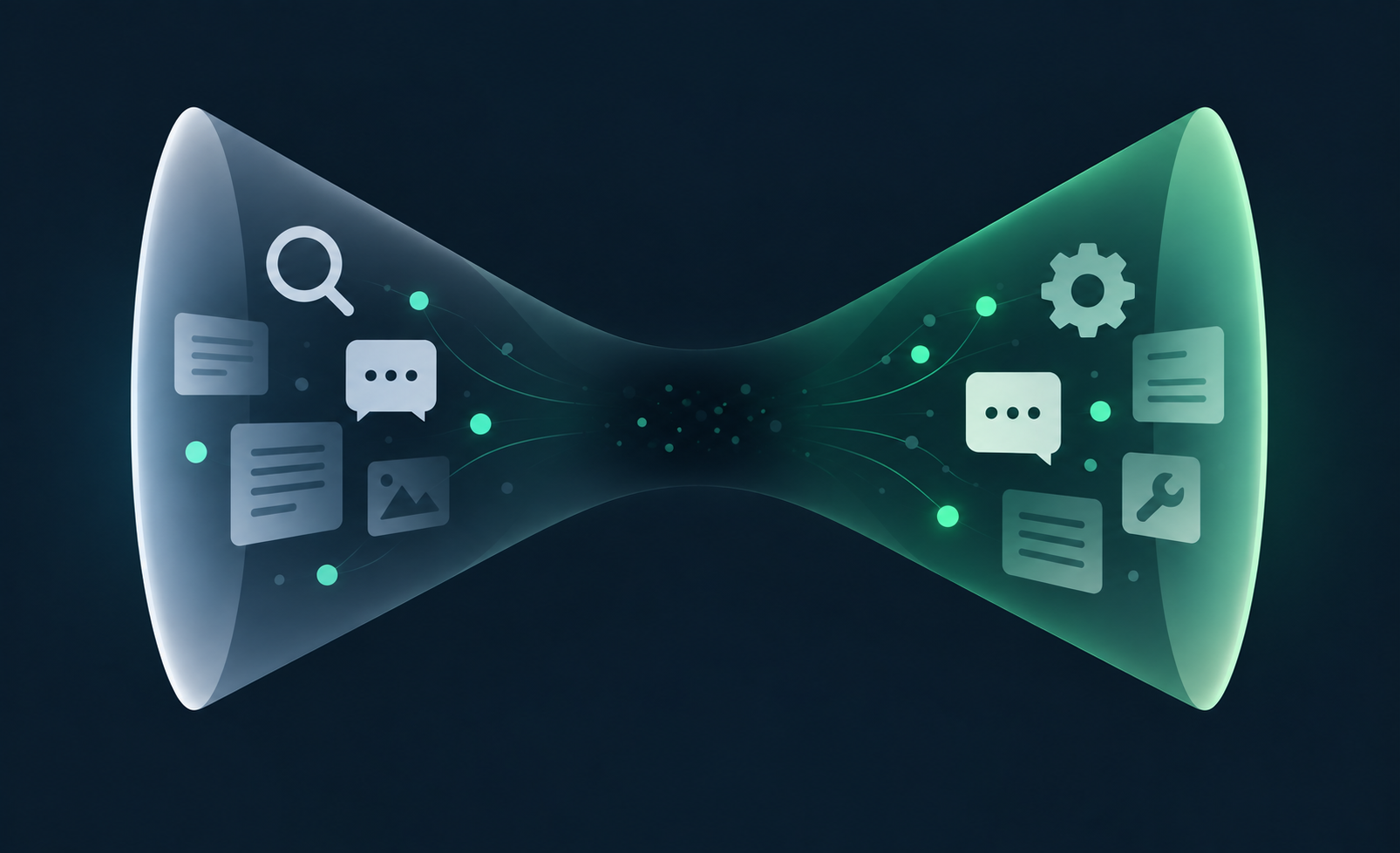
Marketing teams have started to accept a hard truth: a growing share of buyer research happens where they can’t see it. Prospects ask ChatGPT to compare vendors, research a category, or scope out an implementation plan long before anyone picks up the phone.
We wrote about this in What Is the AI Demand Channel?: buyers show up already informed, or misinformed, by conversations no one on the vendor side ever sees.
This goes beyond discoverability and getting your name mentioned. The dark funnel now runs deep into the evaluation stage, where prospects research product features, use case fit, integration scenarios, and time to value.
What gets missed is that the exact same thing happens on the other side of the sale.
The dark funnel doesn’t end at the close.
Once a deal is signed, customers keep using AI the same way buyers did during evaluation. They ask ChatGPT about best practices for their industry, how to configure a feature, troubleshoot an error message, or decide whether a workaround is safe to use in production. If the answer is outdated or wrong, most customers don’t file a ticket. They follow bad advice, struggle in silence, or conclude the product doesn’t work as advertised. We covered this directly in DIY AI Support: The Post-Sales Dark Funnel: the same invisibility that costs marketing a deal costs an expansion opportunity, and sometimes a renewal.
One phenomenon, two departments, zero visibility.
Put the two side by side and the pattern is obvious. Before the sale, a prospect gets a wrong answer about pricing or compliance from an LLM and quietly removes a vendor from consideration. Marketing never finds out a prospect existed. After the sale, a customer gets a wrong answer about setup or configuration from the same kind of source and quietly assumes the product is broken or just not a great fit after all. Support never finds out there was a problem.
Both failures share the same root cause: AI has become the first, and sometimes only, channel a buyer or customer uses to get an answer, and no one owns the accuracy of what it says. Marketing owns the website. Support owns the self-service journey. Neither owns ChatGPT’s answer, Gemini’s answer, or Claude’s answer, and none of the analytics either team already has will show them what’s happening there. At best, they see traffic to the self-service website diminish over time.
Most companies still treat these as two separate problems, one for demand generation and one for customer support, because they sit in different departments with different metrics and different owners. But the underlying issue is identical in both cases: an AI channel is answering questions about the business, its products, and its services, and nobody is checking whether the answer is right and the positioning is correct. On top of that, public LLMs don’t distinguish between marketing content and support content either. They absorb it all to answer every question.
Why this matters now
This isn’t a hypothetical risk. It’s happening today, continuously, across every company with any AI visibility at all, and it will only grow as more of both buyer research and customer self-service moves through conversational AI instead of search or documentation. The companies that get ahead of it will be the ones who stop treating pre-sale and post-sale AI visibility as separate initiatives and start treating them as one problem: what does AI tell people about us, and is it true?
isalo tests both sides of that conversation continuously, so a lost deal or a churned customer isn’t the first signal something went wrong.
If you’re only watching one side of this funnel, you’re only seeing half the problem.