AEO has quickly become a priority for B2B marketing teams. Companies want to know whether they appear when buyers ask ChatGPT, Claude, Gemini, or Perplexity about their category, products, and competitors.
They are beginning to track metrics such as Share of LLM, citations, query coverage, and competitive visibility, and to optimize content so AI systems can better understand and represent their products.
That work matters. If a buyer asks an AI system for the leading vendors in your category and you never appear, you may never make the shortlist. But being discovered is only the beginning of the buyer experience.
Consider a prospect researching your company. ChatGPT recommends you and accurately describes your product, so your AI visibility metrics look great. The buyer then visits your website and cannot determine whether you support a critical integration. They ask your chatbot, which provides an incomplete answer. They look for pricing and find conflicting descriptions of your packaging. Finally, they return to ChatGPT and ask how you compare with a competitor, only to get an answer based on a product limitation you removed a year ago.
From an AEO perspective, you may have succeeded. You appeared in the original answer, you were cited, and your Share of LLM increased. From the buyer’s perspective, the experience failed. As we explored in You’re Winning Share of LLM. Why Are You Still Losing the Deal?, visibility tells you that AI found you. It does not tell you whether the information a buyer receives is accurate, useful, or helping you win.
AEO solves only part of the buyer journey
We introduced the AI Demand Channel to describe the commercial environment in which buyers increasingly use AI to discover categories, research vendors, evaluate products, and prepare for conversations with sellers. AEO is an important capability within that channel because it helps companies become discoverable and understandable when buyers use AI to research a market.
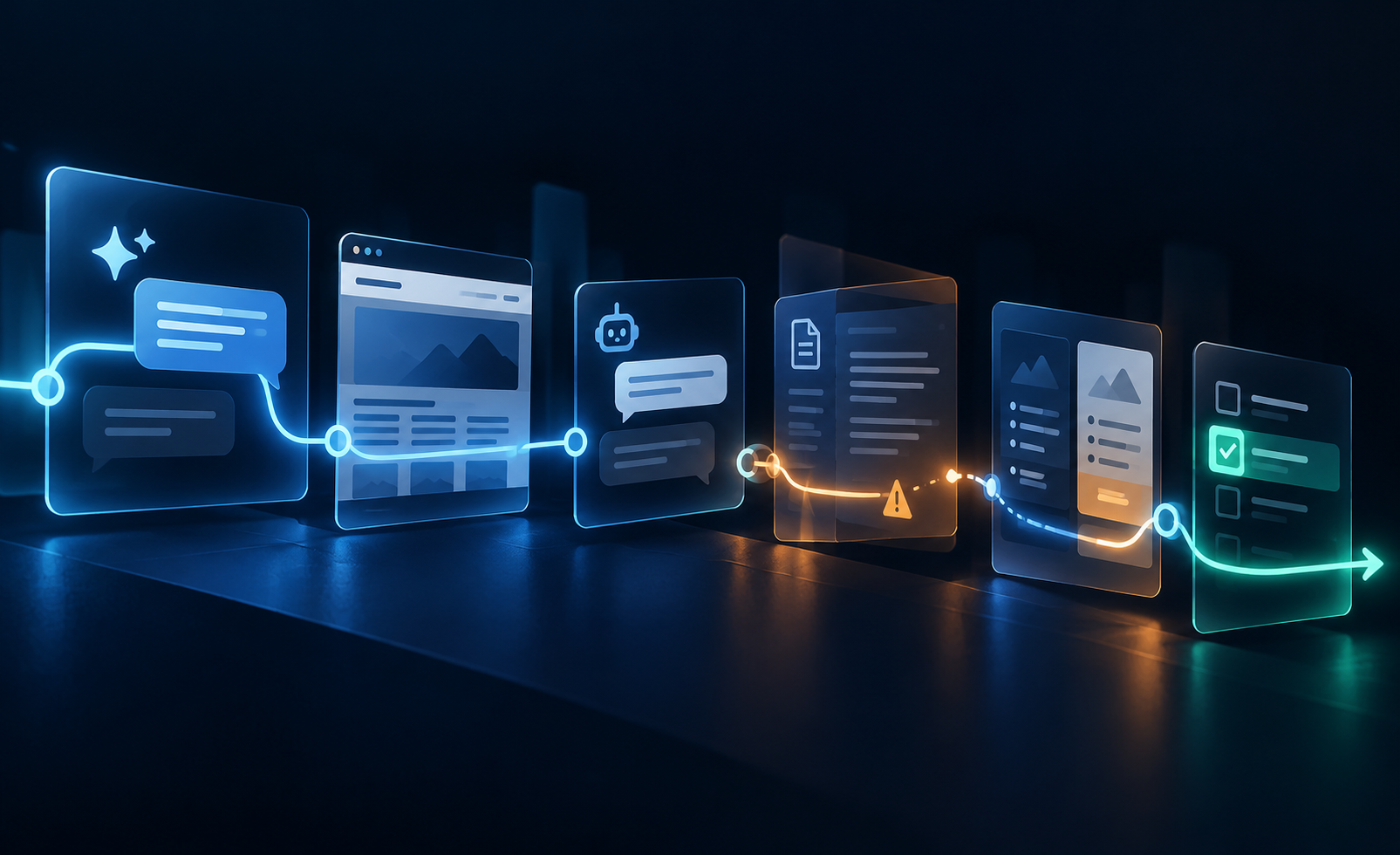
But buyers don’t stop evaluating a company once ChatGPT mentions it. They move between public AI systems, websites, product pages, documentation, communities, chatbots, and eventually conversations with Sales. They may begin with ChatGPT, move to your website to validate what they learned, ask your chatbot a technical question, return to Claude for a competitive comparison, and then decide whether talking to your sales team is worth their time.
That means the unit of analysis needs to expand beyond the AI mention or citation. The more important question is whether the buyer can successfully accomplish what they came to do.
Imagine a VP of Customer Support evaluating AI support platforms. She needs enterprise SSO, Zendesk integration, multilingual support, clear information about implementation requirements, and enough pricing information to determine whether a vendor is even plausible for her company. Her goal is to narrow six potential vendors to three before talking to Sales.
An AEO program might measure whether your company appears when she asks ChatGPT for vendors that meet those requirements. Buyer Experience Testing goes further. It asks what happens as she actually tries to evaluate you. Can she verify the integrations on your website? Does your chatbot give her a useful answer? Can she understand your differentiation? Does your documentation reinforce or contradict what she learned elsewhere? When she asks AI to compare you with a competitor, is the answer accurate and current? At the end of the journey, does she have enough confidence to put you on the shortlist?
This is essentially digital mystery shopping for the B2B buying journey.
From AI visibility to Buyer Experience Optimization
Once you look at the journey this way, visibility becomes one dimension of a much broader digital buying experience. A company can perform well in public AI and poorly on its website. Its website can explain a capability clearly while its chatbot gives an outdated answer. The correct information may exist somewhere in the documentation, but a prospect unfamiliar with the company’s terminology may never find it.
Testing the buyer experience therefore requires looking at several dimensions together. Is the information accurate and complete? Are material facts consistent across channels? Does the experience communicate the positioning and differentiation you intended? Can the buyer find and use the information? Most importantly, can the buyer successfully accomplish the evaluation task?
One test gives you a snapshot, but the environment keeps changing. Your products change, competitors reposition, pricing evolves, documentation gets updated, websites are redesigned, chatbots ingest new knowledge, and public AI systems change as models and available information evolve. Important buyer scenarios therefore need to be tested repeatedly to understand whether the experience continues to work.
This creates a progression from Buyer Experience Testing to Buyer Experience Monitoring and ultimately to Buyer Experience Optimization.
Monitoring tells you when an important scenario changes or fails. Optimization turns those findings into action. The operating loop is straightforward: test realistic buyer scenarios, identify meaningful failures, prioritize the ones that matter, fix the underlying problem, verify the improvement, and repeat.
We think of Buyer Experience Optimization as the discipline of continuously testing and improving what prospective buyers experience as they research and evaluate a company across digital channels. AEO is an important part of that discipline, but the scope is broader because the buyer experience extends across public AI, the website, chatbots, documentation, and other self-service channels involved in the evaluation.
This distinction also builds on a broader shift we’ve been seeing across the customer journey. As we wrote in The Dark Funnel Doesn’t Stop at the Sale, public AI and digital self-service increasingly span both sides of the transaction. The same documentation, product information, and AI systems can influence a prospect evaluating a vendor and a customer trying to use the product months later.
AI changes the economics of testing the buyer experience
Digital mystery shopping is not a new idea, but historically it has been expensive to perform continuously. A person has to follow a journey, document what happens, compare the results with what should have happened, and determine whether the differences matter. Doing that across hundreds of buyer scenarios, products, competitors, channels, and AI systems quickly becomes impractical.
AI agents change the economics. They can execute representative buyer scenarios across public LLMs, websites, documentation, and chatbots, repeat those tests over time, capture changes, and identify potential inconsistencies. Instead of periodically auditing a handful of journeys, companies can begin continuously testing a much broader set of experiences.
Human judgment remains critical because not every difference is a problem. Two channels may describe the same capability differently without affecting the buyer’s understanding, while one incorrect answer about a critical integration could eliminate the company from consideration. AI can provide the breadth and frequency of testing; people still need to determine what matters, why it matters, and what should be fixed first.
This combination also creates a different operating model. Companies can build this testing capability internally, buy tools and assign teams to operate them, or consume the capability as an ongoing service. isalo’s Buyer Experience Optimization service applies this model by using AI agents to continuously test realistic buyer scenarios across public AI systems, websites, and company chatbots, with human review to validate findings and prioritize recommendations. It is an example of the broader AI-native service model we’ve been developing at A6, where the customer buys the ongoing outcome rather than another software platform their team has to operate.
Marketing’s responsibility is expanding
For years, digital marketing was largely organized around getting buyers to the website. SEO generated discovery, paid media generated traffic, content created engagement, and forms captured demand. Once a buyer arrived, the company’s digital properties and eventually Sales took over.
AI changes that architecture because significant parts of research and evaluation can now happen before the buyer visits your website or talks to anyone at the company. The buyer may arrive with a shortlist, an understanding of your positioning, a view of your strengths and weaknesses, and detailed questions about pricing, integrations, implementation, and customer experience. Some of that understanding may be correct and some of it may not be.
Once the buyer reaches your website, the journey does not suddenly become company-controlled again. They can move back and forth between your content, your chatbot, public AI, documentation, communities, and other sources throughout the evaluation. The distinction between “AI visibility” and “website experience” makes sense organizationally, but it makes much less sense from the buyer’s perspective.
That creates an ownership problem. SEO may own search visibility, Digital may own the website, Product Marketing may own positioning, Demand Generation may own conversion, and Sales may own the direct conversation. Each team can optimize its part while nobody asks whether the complete digital prospect experience actually works.
AEO is forcing companies to confront that question because AI makes the gaps more visible. Getting mentioned by ChatGPT is valuable, but it is ultimately just one moment in a much larger journey.
The next question for marketing teams is no longer simply, “Do buyers find us in AI?” It is “Can buyers successfully understand and evaluate us across the entire digital experience?”
That is the shift from AI visibility to Buyer Experience Optimization.